
The cafés are quieter now. The smoke has cleared. Sartre no longer leans over a tiny table in Saint-Germain, de Beauvoir no longer sketches out the architecture of freedom in her notebooks, Camus no longer writes alone with the Algerian sun warming his shoulder. But existentialism did not die with them. It merely changed shape—and address.
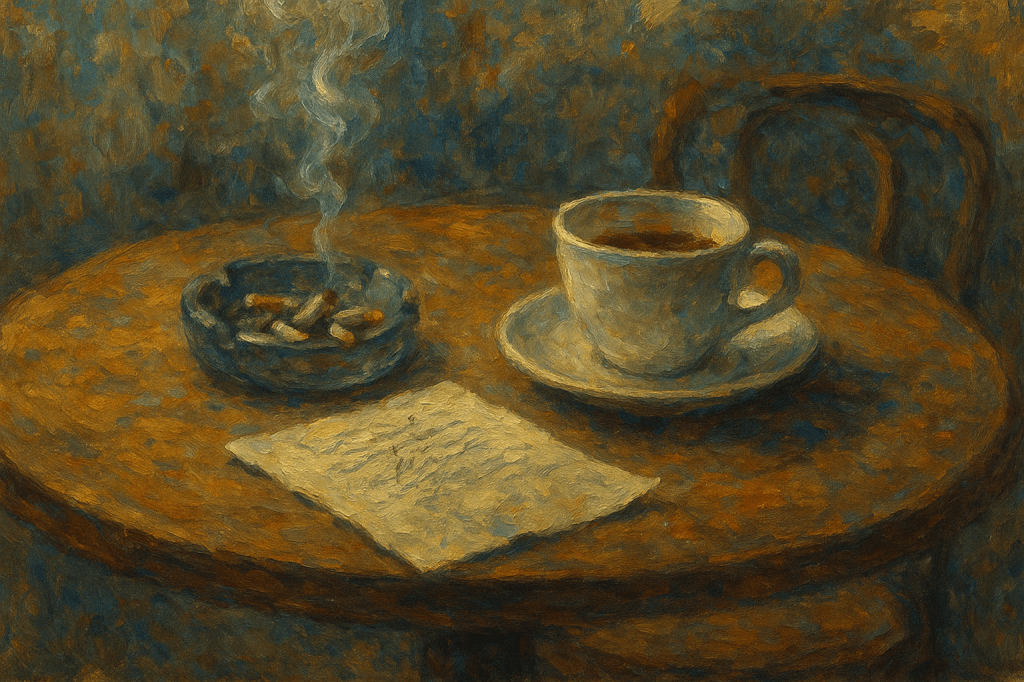
Existentialism was never a closed doctrine. It was an open wound. A question passed from one thinker to the next, whispered across centuries, reshaped by revolutions, wars, borders, and bodies. Its great insight—that we are free, and that freedom is a burden—was too honest to be fashionable, too enduring to be forgotten.
Its thinkers did not write from a place of comfort—they wrote from the edge, staring down meaninglessness with trembling hands. And that’s what gave their ideas power. They were not abstract systems. They were responses. Rebellions. Lifelines.
And these thinkers—let’s be honest—were not saints.
They argued. They betrayed. They drank too much, loved too messily, hurt people, and hurt themselves. They were arrogant, brilliant, scared, radical, unfinished. And because of that, their philosophy rings true. It’s not about becoming perfect. It’s about becoming real. About facing the absurd without flinching, even if your voice shakes.
Sartre, de Beauvoir, and Camus lit the match—but they didn’t light it alone. The flame traveled—through quieter minds, louder hearts, different languages. And always, it passed through life first.
Gabriel Marcel: Tenderness as Resistance
“To hope is to give oneself to the future—and that, in turn, is to risk disappointment. But also, love.”
Gabriel Marcel was one of the first to receive it—though his warmth ran counter to Sartre’s fire. A composer and playwright before he became a philosopher, Marcel believed in mystery more than mastery. His diaries are full of heartbreak, illness, and spiritual doubt. But from that fragility, he built something radical: hope.
While Sartre wrote of nausea and abandonment, Marcel offered fidelity—a steady commitment to others, not because life is certain, but precisely because it’s not. He saw human beings not as projects to manage, but as presences to encounter. His thought was softer, but no less rebellious. His legacy? A quiet resistance rooted in tenderness.
Maurice Merleau-Ponty: Meaning in the Body
If Marcel reached for the soul, Maurice Merleau-Ponty returned us to the body. Where others debated essence, he studied gestures. In Phenomenology of Perception, he described how meaning arises through touch, vision, and motion—the way a child learns to reach, or how we navigate a room without thinking.
Merleau-Ponty, once Sartre’s close collaborator, drifted away when political allegiance demanded certainty he could not offer. He chose ambiguity instead—believing that truth often trembles, and that’s no reason to discard it. His influence ripples into feminism, art, and even neurology. He reminded us that to exist is not only to think—but to feel one’s way through the world.
Frantz Fanon: Freedom by Force
That sense of alienation in one’s body would echo, with searing clarity, in the writings of Frantz Fanon. A psychiatrist from Martinique trained in France, Fanon took existentialism to the colonial frontlines. In Black Skin, White Masks, he used Sartre and Merleau-Ponty’s frameworks to unmask the psychic violence of racism. But he didn’t stop there—he turned them against the empire itself.
“We revolt simply because, for many reasons, we can no longer breathe.”
Fanon joined the Algerian revolution. He treated the tortured and the torturers. And as his body was succumbing to leukemia, he dictated The Wretched of the Earth—a final howl against dehumanization and a radical plea for liberation. His message was clear: freedom is not given. It must be seized. And philosophy, if it does not serve the oppressed, is merely decoration.
Hannah Arendt: Action Against Absurdity
While Fanon fought in the colonies, another exile—Hannah Arendt—was redefining what it meant to act in the world. A Jew who fled the Nazis, a woman in a male tradition, a student of Heidegger who refused his darkness—Arendt never stopped thinking. But for her, thinking was not enough.
“The most radical revolutionary will become a conservative the day after the revolution.”
In The Human Condition, she argued that our humanity is realized through action with others. Not isolation. Not introspection. Appearance. To be human is to be seen, to speak, to build a shared world. Her notion of natality—the power to begin anew—may be existentialism’s most daring act of faith.
Rollo May: The Therapist of the Abyss
From public life to private struggle, Rollo May brought existentialism into the therapy room. He sat not in cafés, but in quiet offices, with patients unraveling at the seams. In Love and Will and The Meaning of Anxiety, he suggested that suffering wasn’t a symptom to silence—it was a message.
May’s own life was shaped by illness and loss. Yet he chose to lean into those experiences, believing that anxiety reveals where growth is possible. His work humanized existentialism, giving ordinary people a language for the fear, desire, and courage woven into their everyday lives.
Judith Butler: Performing the Self
That language found new forms in the late 20th century, especially through the work of Judith Butler. Reading Beauvoir, Butler asked: if gender isn’t destiny, then what is it?
Their answer: performance. In Gender Trouble, Butler argued that identity is something we do, not something we are.
“We are always in the process of becoming, and identity is a negotiation, not a destination.”
Their life—as a queer, Jewish, academic outsider—reflected this refusal to conform. They took existentialism’s cry of “existence precedes essence” and translated it into resistance against gender norms, binaries, and the illusion of fixed identity. Sometimes, freedom doesn’t shout—it survives.
Cornel West: The Blues Philosopher
Cornel West takes that same survival and sets it to music. A philosopher of jazz and justice, West fuses existentialism with the Black prophetic tradition. In Race Matters, he writes with fury and love about a society that devours its most vulnerable. He calls himself a “blues man” who hopes without optimism—only courage, sorrow, and radical love.
For West, existentialism is not intellectual posturing. It’s showing up—with a broken heart and a stubborn will. He doesn’t talk about authenticity. He sings it.
Byung-Chul Han: The Whisper of Rebellion
And then, in our own time, Byung-Chul Han enters quietly, like a shadow in a glowing screen. Reclusive, soft-spoken, and razor-sharp, Han diagnoses our digital malaise in books like The Burnout Society and Psychopolitics. Where Sartre feared the gaze of the Other, Han fears the algorithmic gaze we invite.
In his world, repression is outdated—we now exploit ourselves, polishing our lives for the invisible approval of data. We are free, but only to exhaust ourselves. Han’s rebellion is subtle. It doesn’t march. It logs off. In his silence, there’s an echo of Camus: refuse to play the game, and you’ve already won.
Beyond Philosophy
Existentialism began with thinkers—but it didn’t end there.
It spilled over into literature, theater, punk rock, graphic novels, anime, video games, and even TikTok confessionals. It left behind the café tables and entered therapy rooms, protest marches, midnight playlists, and meme culture. It whispered into the ears of those asking, “Who am I, really?” and “Why does any of this matter?”
Its thinkers are gone. But their lives—their contradictions, their defiance, their cracks and tremors—still haunt us. And their rebellion continues in every act of refusal, every hard-won choice, every quiet, trembling yes.
Because this was never about finding answers. It was about finding a way to live without them.
“To be human, at the most profound level, is to ask unanswerable questions—about death, dread, despair, and disappointment—and still muster the courage to love.”
— Cornel West, The Cornel West Reader
 Eksistensialisme.com