He sat apart, as always. The café rang with voices—Sartre gesturing over Marx, Beauvoir slicing the air with smoke and wit. But Camus said nothing. Not tonight. Not here. He scribbled one word onto a crumpled page—Algiers—and stared through the noise. While others chased truth in arguments and absinthe, he carried it like dust on his skin. In this Parisian theater of ideas, Camus was not excluded. He exiled himself—by instinct, by necessity.
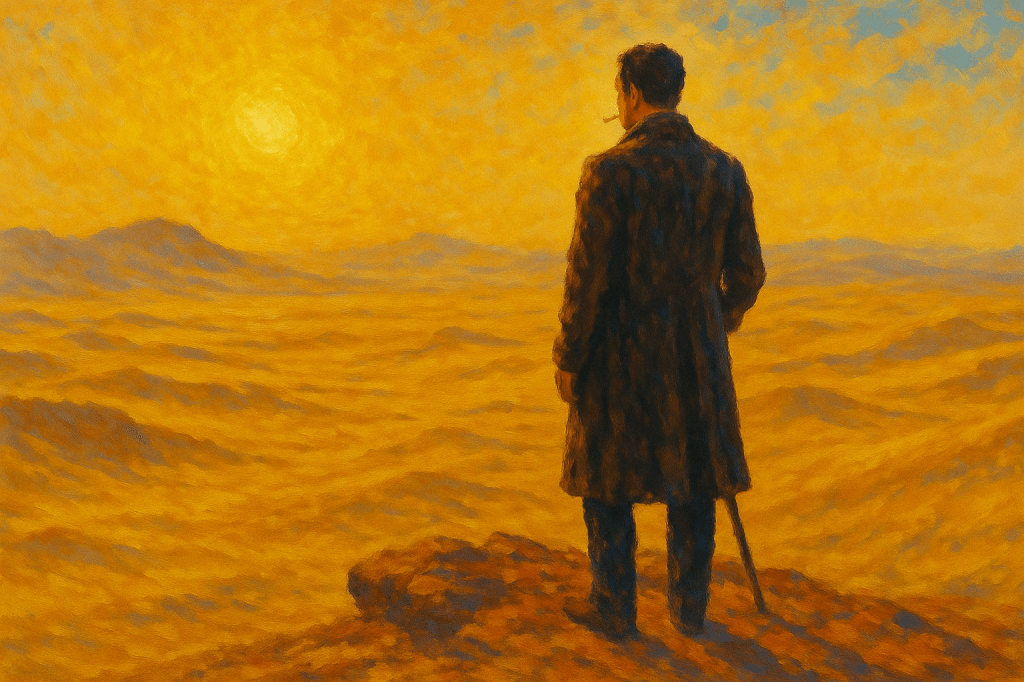
It was a place of contradiction—too bright to forget, too harsh to romanticize. The sun didn’t just shine; it punished. Heat shimmered off the stone streets, dust clung like a second skin, and the salt air off the Mediterranean sliced through even the thickest summer haze. In Algiers, where Albert Camus was born in 1913—there was no shade. Only stone, sweat, and survival.
Life in Belcourt, one of the poorest region in the country, was cramped, physical, and nearly wordless. Camus grew up in a two-room apartment with no electricity, no running water, and barely enough space to think. His father, Lucien, died in World War I from a shrapnel wound to the head at the Battle of the Marne—too soon for Albert to remember. All he inherited was a photograph and a grave.
His mother, Catherine, was half-deaf and almost entirely illiterate. She worked as a cleaner and rarely spoke. When she did, it was in short, practical bursts—never ideas, never reflection. Camus would later write that her silence shaped him more than any book ever could. She lived with a quiet dignity born not of thought, but of endurance. She didn’t ask questions of life. She bore it.
The house, however, was ruled by his grandmother—strict, unyielding, and unsparing. When Camus wore out his shoes, she beat him. There was no space for tenderness. Discipline came first. Emotion had no rank. It didn’t take long for Camus to understand that survival required silence, order, and resilience.
And yet—outside their door, beauty waited. Brutal beauty. The sea sparkled like a lie, the hills baked under a pitiless sky. Children kicked footballs barefoot in the alleyways, their laughter bouncing off cracked walls. It wasn’t paradise. It was the absurd in its purest form: joy without security, light without shelter, beauty without mercy.
Camus would later describe his childhood as lived à mi-distance de la misère et du soleil—halfway between misery and the sun. The sun taught him joy. Misery taught him truth.
At seventeen, tuberculosis struck. It shattered his body and ended his dreams of becoming a footballer—a goalkeeper, the solitary watcher at the edge of the storm. Illness benched him from the physical world and exiled him into thought. He faced death while still a boy. And yet, even then, he did not turn bitter. “There is no love of life,” he wrote, “without despair of life.”
His early essays—L’Envers et l’endroit and Noces—were love letters to Algeria. Raw, lyrical, sun-soaked. They offered no system of thought, only a rhythm: live now, love the moment, feel the sea on your skin before it disappears. These weren’t declarations of belief. They were declarations of being.
This was the crucible in which Camus was forged—not in classrooms or cafés, but in the clash of sunlight and suffering. Not in theory, but in flesh. Before he ever named it, he lived it.
The Exile
Camus left Algiers, but Algiers never left him. Even in Paris, where minds twisted the world into ideologies and theories, he carried the sun with him—blinding, untranslatable, and absolutely real.
As a pied-noir—a French Algerian—Camus occupied an uneasy in-between. He was French by law, but North African by nature. He belonged to the colonizers by name, but not by power. His skin burned under the same sun as the Arabs, but he wasn’t one of them. His heart was tethered to a land that itself was divided. From this tension, his philosophy emerged—not out of speculation, but out of contradiction.
In 1939, as a young journalist for Alger Républicain, Camus reported on the famine in Kabylia, one of the poorest regions in Algeria. What he saw horrified him: malnourished children with distended bellies, families eating roots, colonial authorities turning a blind eye. He wrote with anger, but not with ideology. He didn’t call for revolution. He called for attention. For basic human dignity. That moderation, that refusal to pick a side, would follow him for the rest of his life—and cost him dearly.
By the time he moved to Paris, war was already tightening its grip. Nazi troops had marched into the city. Camus joined the Resistance—not with a rifle, but with a pen. As editor of Combat, the underground newspaper, he wrote with clarity and courage, refusing both fascism and the blind violence that claimed to oppose it. In a time when others shouted, Camus whispered—but his voice cut deeper.
It was during this time that he began to shape what would become his central idea: the absurd. Not as a literary device, but as the raw collision between a world that demands meaning and a universe that offers none. Life, he wrote, is not tragic—it’s absurd. Tragedy implies a moral structure. Absurdity does not. It is the silence that answers our deepest questions. It is the sun, unblinking, over a child’s funeral.
His articulation of the absurd wasn’t just intellectual—it was personal. He had felt it in the silence of his mother, in the indifference of colonial power, in the randomness of tuberculosis. It wasn’t something he discovered. It was something he’d been carrying for years, unnamed.
And yet, Camus did not surrender to despair. The absurd, for him, was not a reason to give up—it was a reason to rebel. Not with hope of victory, but with clarity. To stand up, knowing it changes nothing. To live, knowing death is certain. To find dignity, not in salvation, but in struggle.
The Stranger
Camus didn’t write philosophy in the usual sense. He wrote stories. Sparse, sunlit, unsettling stories—where ideas bled into character, and fiction doubled as confession. He didn’t build systems. He staged confrontations.
In The Stranger (L’Étranger, 1942), Camus gave absurdity a name—and a face. Meursault is a man who cannot lie, who does not perform the expected rituals of grief or guilt. His mother dies, and he feels nothing. He kills a man, and he cannot explain why. He is not a monster. He is simply honest—in a world that demands pretense. And for that, he is condemned. Not for murder, but for not crying at the funeral.
“I looked up at the mass of signs and stars in the night sky and laid myself open for the first time to the gentle indifference of the world.”
― Albert Camus, The Stranger
The novel’s flat, emotionless prose unsettles. It denies readers the comfort of meaning. Everything is bathed in heat, glare, and silence. The sun presses down on Meursault until he cracks. The gunshot is not a climax. It is a consequence. Camus later said that Meursault’s crime was not killing a man—but refusing to lie.
With The Stranger, Camus didn’t just tell a story. He posed a philosophical riddle: What happens when a man accepts the absurd without illusion? The answer, disturbingly, is this: he becomes a stranger—not just to society, but to himself.
In The Plague (La Peste, 1947), Camus widened the lens. Here, the absurd is not individual—it is collective. The town of Oran, gripped by an outbreak, becomes a mirror of wartime Europe. Death is everywhere, indifferent and arbitrary. But the characters do not collapse into despair. They resist—not because they expect to win, but because resistance itself is meaningful.
Dr. Rieux, the narrator, is not a hero. He is simply a man who does what must be done. Day after day, he tends to the dying. He buries the dead. He does not believe in God. He does not believe in salvation. He believes in the living.
Camus called this attitude revolt—the decision to fight even when the war cannot be won. It is not hope. It is not faith. It is dignity.
His novels were not illustrations of ideas. They were acts—extensions of his own defiance. Where others wrote treatises, Camus offered metaphors. He didn’t argue. He invited readers into a world where the absurd had already arrived—and asked them what they would do next.
By the late 1940s, Camus had become something rare: a public thinker whose work was accessible without being simplistic, political without being partisan, philosophical without being obscure. He was a man of the page—but also of the people.
And yet, his clearest statement on the absurd was still to come.
The Myth
“There is but one truly serious philosophical problem,” Camus wrote, “and that is suicide.”
It was a brutal opening, designed to strip philosophy of its comfort and bring it back to the edge of life. The Myth of Sisyphus (1942) wasn’t a cry for despair—it was a challenge: if life is meaningless, why not end it? Camus’ answer was defiant: because even in a world without meaning, we are free to choose how we live. We are free to say no.
In the Greek myth, Sisyphus is condemned to roll a boulder uphill for eternity, only to watch it fall back down each time. A punishment fit for a fool or a rebel. But Camus flips the ending. He imagines Sisyphus happy—not because the task is noble, but because he accepts it fully. There is no appeal to a higher power, no illusion of escape. Just the act. Just the struggle. Just the decision to keep going.
For Camus, this was not a metaphor. It was a life strategy. The absurd cannot be resolved—but it can be resisted. Not with hope, but with clarity. Not with promises, but with presence.
This quiet, radical vision found its way into everything he wrote. While others looked to history for salvation—Marxists, Christians, revolutionaries—Camus looked to the individual conscience. He believed in the value of human life, not in theory, but in practice. And for that, in 1957, the world gave him its highest honor: the Nobel Prize in Literature.
He was 44—the second youngest recipient at the time—and visibly uncomfortable with the recognition. In Stockholm, he spoke not as a man of triumph, but of doubt.
“Each generation, doubtless feels called upon to reform the world. Mine knows that it will not reform it, but its task is perhaps even greater: it consists in preventing the world from destroying itself.”
It was not a victory speech. It was a warning.
Paris applauded, but not everyone was clapping. Some critics accused him of being apolitical, too moralistic, too vague. Sartre and his circle, committed to revolution and Marxist action, saw Camus as increasingly isolated, out of step with history.
But Camus didn’t care for applause. What mattered was integrity. What mattered was bearing witness.
The absurd wasn’t solved with awards. It remained, like Sisyphus’s stone, waiting to be pushed again.
The Rebel
By the late 1950s, Camus had become a celebrated writer, a public moralist, and a reluctant icon. But at the center of his identity, one thing remained unresolved: Algeria.
The land that raised him—the sun-drenched streets, the silence of his mother, the rhythm of the sea—was now tearing itself apart. The Algerian War had begun. The French colonial regime clung to control. The National Liberation Front (FLN) fought for independence. And Camus stood in the middle, unable to fully belong to either side.
He could not support colonial brutality. But neither could he endorse a revolution built on terror. What he wanted—what he pleaded for—was something no one was offering: a civilian truce. A space where innocents might be spared, where violence might pause long enough for humanity to speak.
In 1956, he made his case publicly: “I believe in justice, but I will defend my mother before justice.” It was not an argument. It was a confession. And it cost him dearly.
To the French Left, it was cowardice. To Algerian revolutionaries, it was betrayal. To Sartre, it was moral weakness. The man who once shared cafés and conversation with Camus now dismissed him in print. Their break was not just political—it was metaphysical. Sartre believed in history. Camus believed in limits.
Camus’s The Rebel, a philosophical essay on revolution and its moral boundaries, had triggered the rupture. In it, he argued that rebellion, if untethered from ethics, collapses into tyranny. The twentieth century, he believed, had traded one absolute for another—God for ideology, salvation for revolution. And the result was slaughter.
Sartre, ever the dialectician, saw this as naïve. Revolution required dirty hands. Camus refused the stain.
He withdrew from the public fight. Not out of apathy, but because the fight itself had lost its shape. He no longer trusted the shouting. He returned to the quiet he knew best—his notebooks, his fiction, his memories of Algiers.
In private, he despaired. The sun he once worshipped now cast no warmth. He felt, more than ever, like a man without a country. In France, he was a colonial. In Algeria, a traitor. In Paris, a prize-winner. In his heart, a child from Belcourt.
It was not a political dilemma. It was the absurd, once again—only this time, it had a name. And it was tearing him in two.
The Absurd
It was winter in northern France—quiet, gray, cold. The trees were bare, their branches etched against the pale sky like ink on old parchment. The road from Burgundy toward Paris stretched empty that morning, cutting through villages still sleeping under the January frost. Somewhere near the town of Villeblevin, the silence broke.
The car—a sleek black Facel Vega—was traveling fast. Michel Gallimard was at the wheel. Camus, in the passenger seat, was relaxed. He hadn’t planned to take the car at all; he had a train ticket in his coat pocket. But Gallimard had offered the ride, and Camus, uncharacteristically, said yes. It was supposed to be quicker. More comfortable. A detour toward convenience.
The tires slipped on the wet road. Maybe the speed was too much. Maybe the tread too worn. Maybe it was just fate, wearing a French license plate. The car veered, struck a tree, and crumpled.
Camus died instantly.
Scattered in the wreckage was the unfinished manuscript of The First Man—a raw, autobiographical novel that might have been his most human work. It was meant to be a return. Not to Paris, not to philosophy, but to Algiers. To the boy with the silent mother. To the barefoot streets. To the sun.
He had spent his life haunted by that light, and now, in the dead of winter, it was gone.
The irony was unbearable. A man who spent his life exploring death, randomness, and absurdity—taken not by ideology or illness, but by a snapped tire on an ordinary road. No grand finale. No symbolic closure. Just an accident. One of those cold, indifferent facts the universe specializes in. The kind Camus had spent his career staring down, refusing to look away.
It was, in every way, absurd.
And yet, fitting. Camus had always argued that the absurd is not a theory—it’s a condition. It waits for everyone in the quiet moments: at funerals, in diagnoses, in sudden departures. It demands no explanation. Only response.
For Camus, that response was always rebellion—not with slogans, but with sincerity. To live, not because life was sacred, but because it was here. To write, not because truth could be captured, but because it must be chased. To choose dignity, even when history offered only despair.
In his eulogy, Sartre—despite their rift—called him “the last moralist of France.” But that’s too narrow. Camus wasn’t preaching. He was witnessing. Not as a prophet, but as a man who had seen the sun fall on broken buildings, and still believed in walking forward.
Today, Camus is still hard to categorize. Too lyrical for the philosophers. Too principled for the politicians. Too honest for the ideologues. But that was always the point.
Camus never asked to be a philosopher. He did not draft systems or command followers. He bore witness. To poverty. To injustice. To joy. To absurdity. He asked us to walk the same path—not toward meaning, but toward dignity.
In the end, Camus’s legacy isn’t carved in marble. It endures in those who choose defiance over resignation, awareness over illusion, kindness over cruelty. In those who, even in silence, still say yes.
Among his most enduring words came not from a philosophical treatise, but from a return—a quiet essay titled Return to Tipasa, written after years of war and exile. There, standing once again in the sunlit ruins of his youth, Camus did not find answers. He found something greater: a reminder of joy, despite it all.
“In the midst of winter, I found there was, within me, an invincible summer.”
And perhaps that was the absurd hero all along.
 Eksistensialisme.com