
As a philosophy that centers on the freedom of the individual, existentialism cannot be fully understood apart from the people who lived and breathed it. The cafés of Paris in the early 20th century were more than places for coffee—they were incubators of ideas, obsessions, and revolutions.
Paris, on the cusp of 1933. At a small bar called Bec-de-Gaz on rue du Montparnasse, three young philosophers shared drinks, gossip, and debate over apricot cocktails. Simone de Beauvoir, 25, sat beside her partner Jean-Paul Sartre, then 27, as their friend Raymond Aron returned from his studies in Berlin.
Aron begins sharing stories about a new philosophical movement in Germany: phenomenology, a method of understanding phenomena through direct experience. He speaks with infectious excitement about Professor Edmund Husserl’s famous call—“To the things themselves!”—urging students to bypass abstract essence and turn instead to lived existence.
“You see, mon petit camarade,” Aron said, lifting his glass, “if you’re a phenomenologist, you can build an entire philosophy just by observing this cocktail.”
Sartre turned pale. In that moment, he saw it: a philosophy not of pure reason, but rooted in the mess and immediacy of real life.
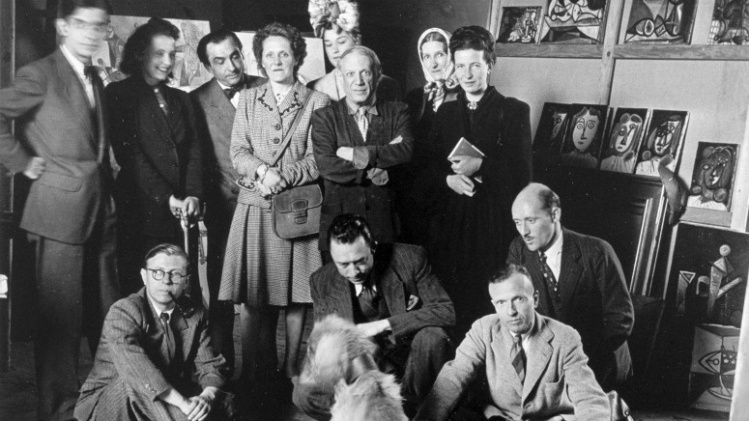
According to many accounts, existentialism found its modern roots in the cafés of Paris—particularly in places like Café de Flore, Les Deux Magots, and La Rotonde. These were not sterile lecture halls but living salons, where philosophy unfolded between sips of wine and curls of cigarette smoke. Here, Beauvoir, Sartre, Camus, Merleau-Ponty, Levinas, Marcel, and others debated freedom, meaning, and responsibility—not as abstract puzzles, but as matters of urgent, daily existence.
These thinkers weren’t inventing something entirely new. They were reacting, evolving, and often rebelling against the philosophical traditions before them. Their work was shaped not only by reason, but by biography—by illness and heartbreak, war and exile, gender and class.
Take Edmund Husserl, the founder of phenomenology. Originally trained in mathematics and psychology, Husserl sought to rebuild philosophy as a rigorous science of experience—empirical, methodical, and grounded in what appears to consciousness. His project was a response to what he saw as the overly abstract tendencies of metaphysical philosophy in Europe. He wanted to return philosophy to what was given—to what is lived.
Contrast that with Søren Kierkegaard, often called the father of existentialism. Kierkegaard’s writing was forged in solitude, shaped by his fragile health, devout upbringing, and broken engagement. He didn’t work in laboratories—he wrestled with God in journals and pseudonyms. His books were not systematic treatises but existential cries—obsessions with doubt, despair, and faith in a world that refused to make sense.
Philosophy is not merely subjective, but it is never free from subjectivity. Like any discipline, it relies on logic, analysis, and clarity—but in existentialism especially, the personal bleeds into the philosophical. As Merleau-Ponty once wrote, “Life becomes ideas, and ideas return to life.”
“A discussion is not an exchange or confrontation of ideas,
as if each formed his own, showed them to others, looked at theirs,
and returned to correct them with his own…
Whether he speaks up loud or hardly whispers,
each one speaks with all that he is—his ideas, his obsessions, his secret history.”
— Maurice Merleau-Ponty, From At the Existentialist Café
To truly understand a philosophy, we must understand the person who lived and shaped it. Context matters. So do heartbreaks, revolutions, and cafes.
And so, in this next chapter, we begin not with a concept, but with a man—restless, brilliant, deeply religious, and utterly alone. The man who laid the first stone of what would one day be called existentialism.
References:
 Eksistensialisme.com