
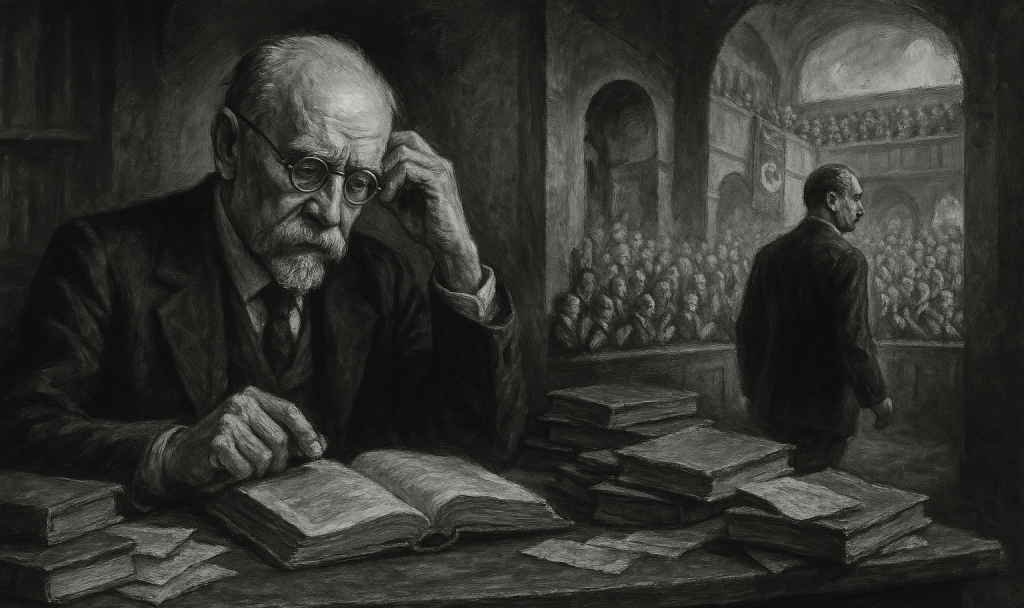
Freiburg, July 24, 1929. The lecture hall was packed. Martin Heidegger had just finished delivering a public lecture on Being and Time, his groundbreaking new book. The audience erupted in applause, but in the midst of the standing ovation, one man remained seated—silent, still. His expression was calm, but his eyes betrayed something deeper. A quiet unease. He knew that tonight was not merely the rise of a brilliant new thinker. It was the beginning of an end—an eclipse. In that moment of thunderous admiration, he felt the weight of two losses: his greatest student… and the philosophy he had spent a lifetime building.
Let’s rewind for a moment—to the Café Bec-de-Gaz on rue du Montparnasse, Paris. It was just after Jean-Paul Sartre first heard about a strange new philosophy gaining momentum in Germany. The story goes that, upon hearing the name, Sartre bolted out of the café and ran to the nearest bookstore. There, he found a book by Emmanuel Levinas titled La théorie de l’intuition dans la phénoménologie de Husserl—The Theory of Intuition in Husserl’s Phenomenology. Too impatient to wait, Sartre began reading the book as he walked back to his apartment.
Something about it felt familiar. He remembered reading a lecture manuscript years earlier by a German philosopher named Martin Heidegger, published in 1929. One thing struck him now with particular force: both Levinas and Heidegger had studied under the same man—Edmund Husserl.
Sartre’s curiosity deepened. This Husserlian method, this thing called phenomenology, seemed to hold something important. It lit a fire in him. So much so, that he traveled to Berlin, hoping to learn more.
But Berlin wasn’t where Sartre should have gone.
The real center of this quiet revolution was a small university town just across the River Rhine: Freiburg.
Freiburg was a university town of about 100,000 people, though that number swelled from time to time as hikers and skiers arrived for weekend getaways—an increasingly popular pastime in the 1920s and 30s. The city was a blend of elegance and serenity, with grand university buildings lining its cobbled streets and a towering cathedral rising in the center, its intricately carved stone spire glowing red under the afternoon sun. At once a Catholic stronghold and an intellectual hub, Freiburg radiated a kind of quiet intensity.
The townspeople, one could say, fell into three categories: tourists, devout Catholics, and the phenomenologists. That last group referred to a particular tribe of students—those who had come to study under Edmund Husserl, the professor of philosophy who taught at the University of Freiburg from 1916 until his retirement in 1928.
Emmanuel Levinas was one of them. He had first encountered phenomenology not through Husserl himself, but through the sight of another student back in Strasbourg poring over a dense German book. Curious, Levinas sought out the text, read it cover to cover, and soon decided to study directly with the man himself. When he finally arrived in Freiburg, he found a community of young thinkers who, like him, felt they had stumbled into something much bigger than a school of thought.
“For the young Germans I met in Freiburg, this new philosophy is more than a new theory; it is a new ideal of life, a new page of history, almost a new religion.”
— Emmanuel Levinas on Phenomenology
Had Sartre gone to Freiburg, he might very well have become a disciple of Husserl himself. But instead, he stayed in Berlin—drinking beer and devouring books on phenomenology, especially those by Husserl. He spent a year there, wrestling with dense German terms and formulating his own take on the method, all without ever meeting the man who had inspired it. Husserl, in turn, likely never heard of Sartre or the philosophy he would later create. Perhaps that was for the best. He might not have been particularly impressed by the radical ideas of the young French existentialist.
Those who did attend Husserl’s lectures in person found someone very different from the image of a fiery revolutionary leading a cult-like movement. Husserl was soft-spoken, with a gentle demeanor, round spectacles, and a neatly groomed aristocratic mustache. When he spoke, he moved his hands slowly and precisely—his right fingers circling the palm of his left, as though illustrating each idea directly onto his own skin.
He was known, too, for his painstaking repetition. He would often return to a single thought again and again, rephrasing it from every angle to ensure his students fully understood. Husserl himself was well aware of this habit. He used to tell a story from childhood, about receiving a pocketknife as a gift. He loved it so much that he sharpened it over and over, until only the handle remained.
“Perhaps my philosophy is like that knife,” he once joked.
Edmund Husserl was born on April 8, 1859, in the small town of Prostějov, in Moravia—now part of the Czech Republic. His family was of Jewish descent but later converted to Christianity, a quiet adaptation that mirrored the subdued beginnings of the boy who would grow into the father of phenomenology.
By most accounts, Husserl was an unremarkable student. A former classmate recalled that he had a habit of dozing off during lessons, sometimes slipping into such deep sleep that when startled awake, he would yawn so wide his jaw would lock in place. And yet, this same boy who slumbered through school would later awaken a generation of thinkers to the very essence of conscious experience.
Even in his youth, there were glimpses of deep affinity—subjects that did not lull him into sleep but called him to attention: mathematics first, then philosophy. Where other lessons blurred into routine, these disciplines held him with an intensity that would never let go.
It was at the University of Vienna where Husserl first encountered the spark that would light the way forward. He studied under Franz Clemens Brentano, a charismatic philosopher and former Catholic priest whose own life bore the marks of rebellion. Brentano had been forced to renounce the priesthood after questioning the Church’s doctrine of papal infallibility—an intellectual heresy that cost him his position but not his convictions.
Brentano wandered across Europe, gathering insights from emerging experimental psychology, before returning to Vienna to teach. There, he began to preach a new gospel to his students: that philosophy must abandon stale scholasticism and return to lived experience. His classroom became a place not of doctrine but of challenge. He urged students to shed blind reverence for past thinkers, to question even the most sacred ideas, and above all, to think with precision.
What Brentano offered was not just content—it was a method, a way of seeing. And in Husserl, that method found its most devoted apprentice.
It was under Brentano’s guidance that Husserl first imagined a philosophy not of speculation, but of seeing things clearly, exactly, as they appear. A discipline not about lofty abstractions, but about how we encounter the world—in perception, in thought, in memory, in time. It would take years for these ideas to mature, but the seed was planted.
The sleepy schoolboy had begun to wake.
The Mad Watchmaker of Freiburg
In 1916, amid the smoldering wreckage of the First World War, Edmund Husserl arrived in Freiburg—a university town framed by the Black Forest, where cathedral bells rang out over bloodstained decades.
It was a year of profound loss.
All three of Husserl’s grown children were swept into the storm. His daughter, Elli, served as a nurse in a field hospital. His eldest son, Gerhart, fought in the trenches and returned wounded. And his youngest, Wolfgang—bright, beloved, just twenty years old—never came home.
Grief folded itself around Husserl like fog. He did not wail. He did not retreat. But something in him dimmed. The philosopher, who had spent years dissecting the structures of consciousness, now faced a deeper, darker inquiry: how to endure unbearable sorrow without losing the very self that suffers it.
And it was here, at the edge of collapse, that he made a quiet, desperate vow:
“I had to philosophize. Otherwise, I could not live in this world.”
—Edmund Husserl
Philosophy became not just his vocation, but his lifeline. In the chaos of war, in the stillness of mourning, Husserl turned to his work not to escape reality—but to face it with unrelenting clarity.
What followed was one of the most intense and prolific periods of his life. He would write feverishly, teach obsessively, and build a new kind of intellectual refuge—not just for himself, but for a generation of young minds seeking light in an increasingly fractured world.
In the aftermath of grief, Husserl did not collapse—he constructed. Philosophy became his scaffolding, his workshop, his daily act of survival. And at the heart of it stood not a monument, but a method: phenomenology.
At the University of Freiburg, Husserl transformed his classroom into something closer to a laboratory. Clad in a crisp jacket, surrounded by towers of paper and precision-cut manuscripts, he would guide his students through the architecture of thought with the obsessive focus of a man rebuilding the world from scratch.
His lectures were intense, his expectations unforgiving. Every idea was dissected, turned over, examined again. He spoke with slow precision, his right hand often circling the palm of his left—tracing invisible diagrams in the air, as if each concept had to be held and turned like a gem before it could be understood. His students called him—half in awe, half in jest—the Mad Watchmaker.
For those who stayed, it was a philosophical bootcamp. But for many, it became something deeper: a way of seeing.
“To follow Husserl’s way of working,” wrote one student, “is to constantly begin again. You are forced to keep returning to the thing before you, to strip away assumptions, to see the world not as you think it is, but as it shows itself.”
This was the essence of phenomenology.
It was not a doctrine, but a discipline. Not a theory of the world, but a method for encountering it. At its core, phenomenology asked only one thing: to return to the things themselves—to describe experience as it is lived, before it is filtered through language, logic, or ideology.
To do this, Husserl insisted, we must suspend judgment. Bracket assumptions. Clear away the inherited clutter of metaphysics, religion, psychology, even science. What remains is not less—but more. The raw phenomenon. Consciousness, stripped down to its elemental architecture.
It was a radical approach. And in a world fractured by war, nationalism, and intellectual orthodoxy, it felt like liberation.
A Legacy Fractured: From Husserl to Heidegger
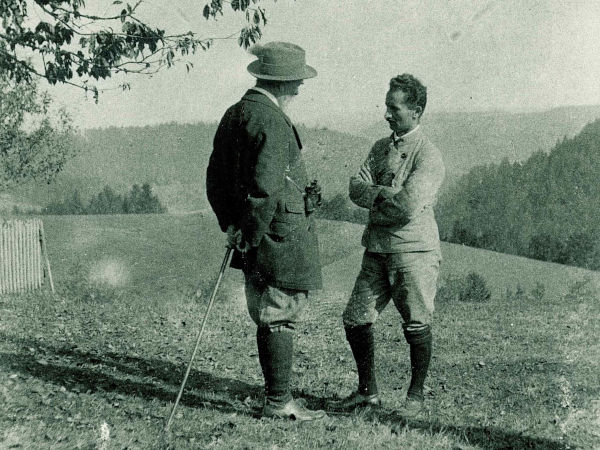
The young minds who gathered in Husserl’s study came from all over Europe—France, Germany, even Russia. Some would go on to become legends in their own right. But none would alter the trajectory of Husserl’s legacy more dramatically than Martin Heidegger.
Heidegger first encountered Husserl’s work in 1909, while still a theology student in Freiburg. Drawn to the rigor and freshness of phenomenology, he became Husserl’s assistant in 1919 and quickly rose as the heir apparent to the Husserlian project. Husserl, impressed by his intellectual fire, once told him: “You and I are phenomenology.”
But the harmony would not last.
In 1927, Heidegger published Being and Time—a revolutionary, dense, and unsettling work that stunned the philosophical world. Drawing from phenomenology but pushing far beyond it, Heidegger shifted the focus from consciousness to Being itself. Where Husserl had meticulously described how things appeared in the mind, Heidegger wanted to know why Being is at all. His focus was not on the how of perception, but the meaning of existence.
It was, in many ways, a brilliant act of rebellion.
To Heidegger, Husserl’s methods were too abstract, too rooted in Cartesian subjectivity. He accused Husserl of clinging to an outdated idea of the self—what Heidegger called the “transcendental ego”—while neglecting the deeper, more primordial structures of human existence.
Heidegger’s criticism stung, not least because it came from someone Husserl had nurtured like family. In public, Heidegger occasionally paid tribute to his teacher: “Husserl opened my eyes,” he said. But in private, the knives were sharper. “I now believe,” Heidegger would later write, “that Husserl was never a philosopher. Not even for a second.”
Still, Husserl continued to support Heidegger. He helped secure his professorship. He lobbied publishers to support Being and Time. And when Husserl retired in 1928, it was Heidegger who inherited his chair at Freiburg—officially becoming his successor.
But the philosophical split was only the beginning.
The year was 1933. A chill was creeping through Germany—not just of winter, but of ideology.
Adolf Hitler had been appointed Chancellor. The Nazi regime was tightening its grip on every institution, and the universities were no exception. A purge of Jewish academics soon followed. Among those affected was Edmund Husserl.
Despite converting to Christianity decades earlier, Husserl was classified as non-Aryan under Nazi racial laws. His books were removed from libraries. His right to teach, revoked. His honorary privileges as a retired professor—stripped away. It was not just a political decision; it was a personal humiliation.
For a man who had lost a son fighting for Germany in the First World War, it felt like betrayal upon betrayal. He had dedicated his life to a country that now rejected him. He had shaped the intellectual architecture of modern German philosophy—only to be cast out from its history.
And then came the silence from Heidegger.
In May 1933, Martin Heidegger joined the Nazi Party. That same month, he was appointed Rector of the University of Freiburg—the very position Husserl once held. In his inaugural address, Heidegger praised the “greatness” of the Führer and the need for Germany to find its destiny. He adorned the university with swastikas. The auditorium where Husserl had taught now echoed with Nazi anthems.
Husserl, now banned from campus, watched his life’s work swept away by politics—and by the very student he had once called his intellectual son.
In a letter to one of his few remaining students, Dietrich Mahnke, Husserl wrote with quiet despair:
“Thanks to a national law, valid henceforth and forever, we are no longer to have the right to call ourselves Germans. Our intellectual achievements will no longer be part of German intellectual history. They will only survive branded with the mark ‘Jewish’—which by all accounts the new regime is determined to make a scar of disdain… a virus that must be eradicated.”
—Husserl, Briefwechsel, Band III
Heidegger never publicly defended Husserl. He never protested the dismissal. He never visited. When Husserl died in 1938, Heidegger cited illness as the reason for missing the funeral. But many saw it for what it was: abandonment.
For Husserl, the philosophical rift had become a moral one. The man who had taught a generation to “go back to the things themselves” was now denied even the dignity of belonging to the nation he had helped shape.
In Quiet Exile
In the final years of his life, Edmund Husserl lived in quiet exile.
Stripped of titles, banned from libraries, erased from academic rosters—he was no longer welcome in the intellectual world he had helped to build. Yet even then, Husserl did what he had always done in times of loss: he returned to philosophy.
In the solitude of his study, he continued to write. To revise. To think. His pen, though shaking, still moved with intention. His mind, though burdened, still sought clarity. And when the shadows of illness closed in, he whispered fragments of ideas—traces of a project he could never finish.
“Philosophy must be begun anew. Radical beginnings. Again and again.”
He spoke these words not to a classroom, not to a nation, but to the nurse beside his bed. In his final winter, he rarely spoke at all. But when he did, it was of beginnings. As though the truth he had spent a lifetime chasing still shimmered just beyond the horizon.
He died in April 1938, in Freiburg. There were no grand commemorations, no state funeral, no flowers from the university. His books were still banned. His name, still excised.
And Heidegger?
He was still Rector. Still a member of the Nazi Party. Still silent.
When word of Husserl’s death reached him, Heidegger sent no public tribute. No statement. He did not attend the funeral. He later claimed illness as the reason for his absence. But to those who had stood by Husserl in his final days, the excuse rang hollow.
Yet the story did not end there.
Husserl’s manuscripts—tens of thousands of pages—were smuggled out of Germany by a former student, Father Herman Leo Van Breda. Hidden in diplomatic crates and sheltered in a monastery, they made their way to Belgium, where they became the foundation of the Husserl Archives in Leuven.
Thanks to Van Breda, the Nazis failed to silence him.
And slowly, after the war, Husserl’s voice returned.
His ideas became central to post-war philosophy. His emphasis on lived experience helped shape the existentialism of Sartre, the humanism of Merleau-Ponty, the ethics of Levinas, and the deconstruction of Derrida. His method—radical, disciplined, compassionate—remained a lighthouse for those who refused to reduce humanity to systems or slogans.
He never wanted to be a prophet. Never sought revolution. He only wanted to see clearly.
He taught a generation of thinkers not what to believe, but how to look.
And for that, Husserl became something rarer than a founder or a rebel.
He became, as some would call him, the last philosopher of Europe—a witness to both the promise of reason and the cruelty of history. A man who believed that even in the darkest times, thought must go on. That to describe the world with care and honesty was, in itself, an act of resistance.
A quiet defiance.
A final gesture of faith.
Not in God. Not in country.
But in the power of consciousness—wounded, wondering, and awake.
References:
- Edmund Husserl Page on Wikipedia
- Phenomenology page on Wikipedia
- The Husserl-Heidegger Relationship in the Jewish Imagination
- At the Existentialist Cafe by Sarah Bakewell
>>> Next Article: Martin Heidegger
 Eksistensialisme.com