
The trauma, destruction, and genocide of World War II forced philosophers to confront a new kind of reality—one that felt absurd, unstable, and deeply human. In response, existentialism emerged as a philosophy of crisis: asking not just what life means, but whether it has any meaning at all—and what role individual freedom, choice, and responsibility play when certainty collapses.
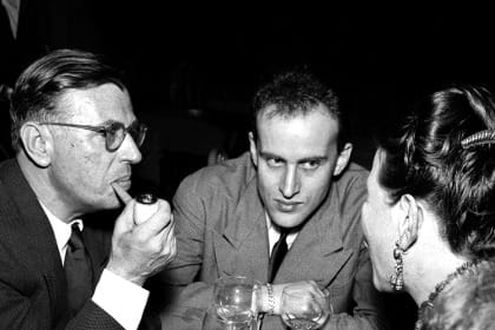
If phenomenology returned philosophy to experience, the next generation of philosophers asked what we are supposed to do with that experience—especially when the world offers no answers.
Existentialism is a philosophy not born in a classroom. It emerged from the cracks of a world in crisis: Wars that shattered ideals. Technologies that distanced us from ourselves. Institutions—religious, political, moral—that had lost their authority.
Its key thinkers didn’t arrive at their ideas through quiet study alone, but through isolation, exile, discrimination, and deep personal confrontation with absurdity.
In 1940, Jean-Paul Sartre was captured by German troops and held as a prisoner of war. In the camp, stripped of rights and freedom, he began to write in secret. What haunted him was not just the physical constraint, but the realization that no matter how confined he was, he could still choose how to respond. It was in that cage—watching others retreat into passivity or delusion—that he glimpsed the terrifying paradox of human freedom: we are never not choosing. Even silence is a choice. Even surrender.
Meanwhile, Simone de Beauvoir grew up learning that her mind mattered less than her appearance, that her freedom was conditional, and that her voice was a guest in a room not built for her. She saw how identity could be shaped—and caged—by society’s expectations.
Far from the philosophical salons of Paris, Albert Camus was a child of poverty in French-occupied Algeria. He knew dust, illness, and silence long before he knew ideas. During World War II, he joined the French Resistance—not with hope, but with determination. For Camus, the world was not tragic—it was indifferent. It did not break you because it hated you. It broke you because it simply didn’t care.
These thinkers did not invent existentialism. They lived it—through captivity, erasure, exile, and resistance.
When the war ended and Europe lay in ruins, they didn’t rush to rebuild old systems of belief. They looked at the rubble and asked the most dangerous question of all: Now what?
If God is dead, if society has failed, if reason cannot explain suffering—then what is left?
The answer was not doctrine. It was a burden:
We are free. We are alone. And we must choose.
From this lived experience, existentialism begins with one radical premise:
Existence precedes essence.
We are not born with a fixed meaning. There is no cosmic blueprint for who we must become.
A tree grows into a tree. A knife is made to cut. But a human being?
A human being is thrown into the world without instructions—and must invent who they are through their actions.
This view is radical because it overturns centuries of thought rooted in essentialism—the belief that everything, including human beings, has an inherent purpose or “essence” that defines its true nature. According to essentialist traditions, you are something before you become someone. Your identity is written in advance—by God, by nature, by society.
Existentialism rejects this.
It says: You are not born with a meaning—you make it.
This is both a liberation and a burden.
Because if nothing is given, then everything you do matters.
Every choice, every silence, every compromise or rebellion becomes a thread in the fabric of who you are.
You cannot blame destiny or design.
You are your choices.
No one captured this tension more sharply than Jean-Paul Sartre.
We Are Condemned to Be Free
In the aftermath of World War II, Sartre stood before a world disillusioned by violence, stripped of meaning, and fractured by history. For him, the collapse of God, morality, and tradition wasn’t just a cultural shift—it was a confrontation with our own terrifying freedom.
“Man is nothing else but what he makes of himself.”
But Sartre did not invent existentialism from scratch.
Before he became its most recognized voice, he was a student of phenomenology—the movement that returned philosophy to the immediacy of experience.
He was deeply influenced by Edmund Husserl, but even more profoundly by Martin Heidegger, whose 1927 masterpiece Being and Time had redefined what it meant to ask the question of existence.
Heidegger had written of Dasein—the human being not as a detached observer, but as being-in-the-world, shaped by time, care, and mortality. Sartre took these ideas and made them his own.
In 1943, he published Being and Nothingness—a direct philosophical response to Being and Time, but with a more personal and psychological edge. At the heart of his book is one searing idea:
Consciousness is nothing.
It has no essence, no substance, no fixed nature. It is not a thing but a space—a gap between what is and what could be. And that gap, that emptiness, is what makes freedom possible.
We are not determined. We are not defined by biology, history, or psychology. We are radically free—so free, in fact, that we often flee from our own freedom. Because freedom is dizzying.
It means that every moment we are choosing, creating, shaping ourselves—and that there is no external justification for our choices.
This is what Sartre calls anguish or existential anxiety—the vertigo we feel when we realize there is nothing holding us in place except our own decisions.
And because that realization is unbearable, many of us choose to lie to ourselves. We convince ourselves that we have no choice, that we are victims of circumstance or roles. We say, “I have to do this—I’m just a teacher, a parent, a soldier, a citizen.”
Sartre called this bad faith (mauvaise foi): the self-deception that pretends we are objects—defined, stable, unfree—when in fact we are subjects, always becoming.
But even in bad faith, we are choosing.
There is no escape from responsibility—not even in denial.
“Man is condemned to be free because once thrown into the world, he is responsible for everything he does.”
We are responsible for or choices. There is no one else to blame.
No destiny to defer to. We carry the weight of our own becoming—whether we acknowledge it or not.
And that responsibility, Sartre argued, extends beyond ourselves.
Every action we take is a statement—not just of who we are, but of what humanity can be. We choose not only for our own lives, but as an example, a mirror, a possibility for others.
And so, existentialism becomes not a philosophy of despair, but a philosophy of resistance. Not against the world—but against apathy and the temptation to look away.
Philosophy that Sparks Revolution
As Sartre’s thought evolved, his gaze turned increasingly outward—from the internal weight of freedom to its consequences in the world.
If every human being is responsible for creating meaning, then that responsibility cannot remain private. It must extend—into society, into history, into how we live with others.
Freedom was not a personal privilege—it was a shared burden.
One we uphold through action, or betray through silence.
After World War II, Sartre became one of the most politically engaged philosophers of his time. He edited radical journals, supported workers’ rights, denounced colonialism, and took often controversial positions on Algeria, Vietnam, and Marxism.
He walked a complicated line—defending freedom, while at times excusing revolutionary violence. But for Sartre, the greatest failure was inaction. Philosophy, he insisted, must leave the page and enter the world.
And that was the true goal of existentialism:
Not to define freedom in theory—but to live authentically.
To resist bad faith.
To act, speak, revolt, and take full responsibility—not only for one’s life, but for the kind of world one’s life helps shape.
And for many, this wasn’t just an intellectual awakening.
It was a revolution.
When Simone de Beauvoir read Sartre’s work, she didn’t simply accept it—she expanded it.
She took the existential idea that “existence precedes essence” and applied it to something that had been long overlooked: womanhood.
“One is not born, but rather becomes, a woman.”
With that sentence, Beauvoir dismantled centuries of essentialist thinking. She showed that gender was not destiny, but construction.
That society doesn’t discover femininity—it assigns it. And in doing so, she laid the philosophical foundation for modern feminism.
Existentialism gave her the tools to show how oppression works—not through brute force alone, but through stories, expectations, and invisible roles.
But existentialism didn’t only shape how we understand identity.
It also reshaped how we understand suffering.
In the Nazi concentration camps, Viktor Frankl, a young Austrian psychiatrist, lost everything: his home, his family, his freedom.
But even there—in the heart of horror—he discovered something profound:
“Everything can be taken from a man but one thing: the last of the human freedoms—to choose one’s attitude in any given set of circumstances.”
And out of that experience, he created logotherapy—a form of existential psychotherapy that asked not what was wrong with the patient, but what was missing.
His guiding insight was simple and radical:
Human beings are meaning-seeking creatures. Even in suffering, especially in suffering, we search for why.
Where Sartre focused on radical freedom, and Beauvoir on liberation from cultural roles, Frankl revealed existentialism’s power in survival itself—when nothing remains but choice.
The Outsider Within: Camus and the Refusal to Justify
As existentialism entered the streets and universities—marching, writing, revolting—Albert Camus took a quieter, lonelier road.
He shared Sartre’s concern for justice and Beauvoir’s belief in human dignity.
But he refused to follow their turn toward ideology, especially when it came at the cost of the individual.
He believed that no cause, no system, no utopia could justify silencing a single human life.
Camus had lived through violence.
Not as a Parisian intellectual, but as a poor Algerian, a resistance writer, and a man who knew both sides of the Mediterranean.
He saw how quickly justice could become cruelty, how ideals could become executions.
And so, while Sartre chose engagement, Camus chose limits.
He rejected existentialism as a label, even though his work remains deeply tied to its questions.
Because for Camus, the greatest confrontation was not between freedom and oppression, but between the human longing for meaning and the silent indifference of the world.
This tension—this unresolved, aching contradiction—would become the center of his next philosophical step: The Absurd.
Not a problem to be solved.
Not a failure to escape.
But a condition to be faced—with clarity, rebellion, and perhaps even joy.
In Camus, existentialism doesn’t dissolve—it mutates.
It sheds its metaphysics and marches into the absurd with nothing but bare hands, dry humor, and defiant hope.
And that is where we’ll go next.
References:
- The Existential Primer
- Wikipedia Page on Existentialism
- “Existentialism is a Humanism”, a lecture by Jean-Paul Sartre
- Man’s Search for Meaning Wikipedia Page, by Victor Frankl
>>> Next Article : Absurdism
 Eksistensialisme.com