Human history does not stand still—and it does not always obey. Along with scientific revolution, came a new philosophy era. A time when people began to believe that light could come not from revelation, but from reason.
The 16th and 17th centuries shattered the comforting notion that Earth was the center of everything.
Galileo Galilei, with nothing more than a simple telescope, revealed that the stars did not revolve around us.
Isaac Newton, with equations and natural laws, showed that the motion of the heavens and the fall of an apple followed the same rules.
Meanwhile, Francis Bacon proposed something radical in its simplicity: if we want to understand the world, we must observe it.
Don’t rely solely on tradition—look. Measure. Test. Question.
From this, the scientific method was born—not a truth handed down by authority, but discovered through evidence.
The printing press, the spread of newspapers, the industrial revolution—all of it fueled a sweeping transformation in how people viewed life.
The old, agrarian world—tied to the rhythms of nature—was giving way to a more urban, dynamic, and rational society.
And philosophy, too, began to shift. It left the cathedrals behind and entered a new domain: one ruled by logic, observation, and common sense.
During this period, Western thinkers began to explore new ideas and develop philosophical methods grounded in reason and empirical evidence—a movement that would come to define the Enlightenment era.
In politics, John Locke and Jean-Jacques Rousseau introduced the idea that governments must protect the rights of citizens—not control them. Concepts like republicanism, democracy, and freedom of speech were no longer utopian dreams, but philosophical imperatives.
In economics, Adam Smith published The Wealth of Nations, laying the foundation for modern economic theory and advocating for free markets and capitalism as mechanisms for human prosperity.
Meanwhile, thinkers like Baruch Spinoza, Voltaire, and David Hume championed reason and scientific inquiry as tools to challenge religious dogma and institutional authority.
For them, progress didn’t come from obedience, but from critical thought—from daring to ask, test, and doubt.
These were not isolated reforms.
They were signs of a broader awakening—a belief that human beings, guided by reason, could reshape the world.
Descartes and the Moment Philosophy Reset Itself
At the forefront of this intellectual revolution stood René Descartes (1596–1650), who made one of the most radical moves in the history of thought: he doubted everything.
Not just superstition or tradition—but reality itself.
Was the world real? Were his senses reliable? Could he trust his memories, his body, even the presence of God?
He imagined the possibility of a malevolent demon deceiving him at every turn. Every belief, every truth, every assumption—he tore them all down, one by one.
Until nothing remained.
Except a voice.
A thought.
A self-aware flicker in the void.
“Cogito, ergo sum.”
I think, therefore I am.
It wasn’t a discovery. It was a rebirth.
From the ruins of doubt, Descartes found a new kind of certainty—not in divine authority, but in the sheer act of thinking.
In that moment, philosophy was reset.
The starting point was no longer faith or inherited truths. It was consciousness—the awareness of oneself as a thinking being.
The self became the foundation. Rational thought became the method.
And the human mind became the new axis around which the universe would be measured.
Descartes lit the torch of reason—but he also split the self in two.
In separating the thinking mind (res cogitans) from the physical body (res extensa), he introduced what would become one of the most enduring dilemmas in Western thought:
the mind–body problem.
If the mind is immaterial and the body is physical—how do the two interact?
If we begin with consciousness, where does the world fit in? Where do others fit in?
This dualism gave rise to both modern science, which focused on the observable, measurable body—and modern subjectivity, which turned inward toward introspection and individual experience.
It was, in many ways, the beginning of a new worldview:
One that prized clarity, logic, and control.
One that saw the universe as a machine—and the mind as the operator.
But that clarity came at a cost.
By placing the self at the center of knowledge, Descartes left open a dangerous question:
If all we truly know is what’s in our mind—then how can we trust anything outside of it?
A century later, Immanuel Kant would step in to confront that question.
He didn’t reject Descartes’ radical doubt—he absorbed it, and asked an even deeper one:
What if we can never know the world as it truly is—only as it appears to us?
With Descartes, philosophy had found its foundation in the self.
With Kant, it would begin to question even that foundation.
Kant and the Limits of Knowing
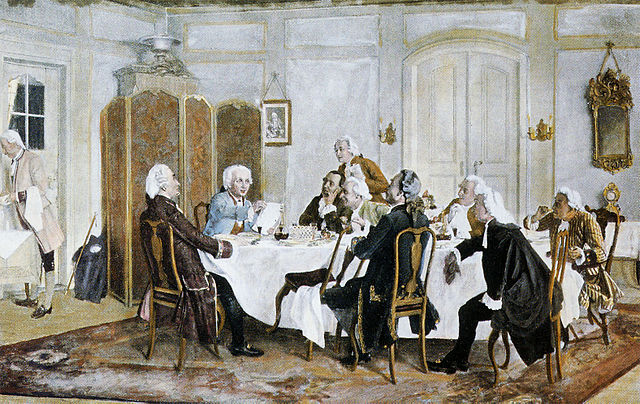
If Descartes shook the foundations of philosophy, Immanuel Kant (1724–1804) quietly reassembled them—only to show that they were never as solid as we thought.
Kant agreed that reason is powerful—but he also saw its limits.
In his monumental Critique of Pure Reason, he asked:
How do we actually know anything?
Do we receive the world as it is, or is it filtered through something—us?
His answer was groundbreaking:
We don’t experience the world directly.
Instead, everything we know comes through the lens of our own mind—space, time, causality.
These aren’t features of the universe. They’re the mental architecture we bring to experience it.
As Kant famously put it:
“All our knowledge begins with the senses, proceeds then to the understanding, and ends with reason. There is nothing higher than reason.”
But this was not a celebration of reason’s dominance—it was a warning.
We may be rational, but we are not neutral observers. We are participants.
We don’t just see reality—we shape it, simply by being aware of it.
Kant completed the shift that Descartes began.
If Descartes placed the self at the center of thought, Kant showed that even the self is shaped by structures we can never fully escape.
We are free—but only within the boundaries of the human mind.
We are rational—but only within the conditions that make experience possible.
Kant left us with a paradox:
We can never know the world as it is—only as it appears to us.
But in that limitation, he found dignity.
Because it means that meaning isn’t just out there.
It’s also in here.
Reason Splits in Two
After Kant, modern Western philosophy began to evolve in two distinct directions:
Analytic philosophy, with its roots in the English-speaking world, emphasized science, language, and logic—searching for clarity through precision.
Continental philosophy, emerging from Europe, turned its gaze inward—toward metaphysics, subjectivity, and the lived experience of meaning.
The difference between these traditions is more than academic.
It reflects two opposing visions of what philosophy is for.
On one side: the philosopher as scientist—carefully analyzing language, refining categories, and building systems of thought like blueprints.
On the other: the philosopher as artist or poet—exploring ambiguity, contradiction, and the chaos of being alive.
In other words, one seeks to calculate; the other to contemplate.
One aims to reduce complexity; the other insists that complexity is the point.
But What About the Human?
This split was not merely methodological—it was existential.
Analytic philosophy, with all its clarity, struggled to account for the messiness of life:
grief, anxiety, love, dread, mortality, meaning.
Continental thought, in contrast, emerged as a response to this absence.
Not a rejection of science or reason—but a refusal to accept that logic alone could explain what it feels like to be human.
It wasn’t enough to describe the world.
The question was becoming more urgent:
What does it mean to live in it?
And so, in the 19th century, as modernity accelerated and certainty began to erode, a new kind of philosophy was born.
It would speak not from the classroom, but from the trenches of the human soul.
It would ask not just how we think, but how we exist.
>>> Next Article: Continental Philosophy
 Eksistensialisme.com