
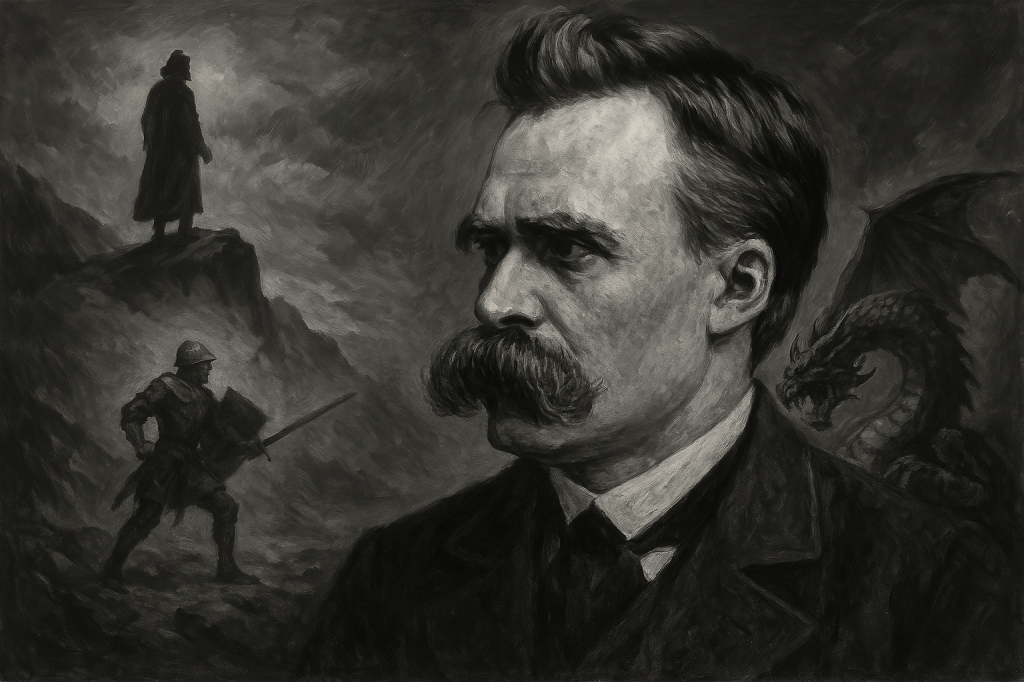
Have you heard of the madman who lit a lantern in broad daylight, ran into the marketplace, and shouted, “I’m looking for God! Where is God?” The people laughed, whispered, mocked him. But then he turned to them, his eyes burning, and cried: “God is dead. And we have killed him.” Silence fell. His lantern dropped, shattered, and went dark. Then he walked away, murmuring, “I’ve come too soon. My time has not yet arrived.”
Nietzsche sat alone in his study. The candlelight flickered against the walls as he wrote feverishly—visions crashing through his mind like thunder. His pen scratched across the page, birthing what would become Thus Spoke Zarathustra, a philosophical epic that felt less like an argument and more like a prophecy. It told the story of Zarathustra, a solitary wanderer who descended from the mountains not with commandments, but with a challenge: to overcome humanity itself.
He spoke not of salvation, but of transformation. He spoke of the Übermensch—the Overman, or Superman—who would rise beyond tradition, morality, even God. But for that future to emerge, one truth had to be faced:
God must die.
In many ways, Friedrich Nietzsche was the very definition of intensity. There was nothing moderate about him. Every idea, every sentence he wrote felt like a thunderclap—demanding attention, provoking reaction, forcing even the indifferent to turn their heads. His philosophy spoke of Gods and prophets, dragons and Supermen. It inspired everything from 2001: A Space Odyssey to the darkest ideologies of the 20th century.
He once titled his autobiography Why I Am So Wise. He challenged not only the world’s beliefs but its very foundations. And even if he had never written a single word, his moustache alone could silence a room.
But his early life was far from that. Nietzsche was born on October 15, 1844, in the small village of Röcken, part of the Prussian Kingdom. His full name—Friedrich Wilhelm Nietzsche—reflected the legacy he was expected to carry. His father, Karl Ludwig Nietzsche, was a respected Lutheran pastor, and his family had long-standing ties to the church. From the outside, young Friedrich’s path seemed predetermined: he was to follow in his father’s footsteps and become a man of God.
As a child, he was so pious and well-mannered that his classmates affectionately nicknamed him “the little pastor.” He was quiet, thoughtful, obedient—traits his family praised as early signs of spiritual devotion.
But that childhood script unraveled quickly.
When Nietzsche was five, his father died from a brain ailment—an event that not only shattered the family but planted the first seeds of doubt in the young boy’s heart. Grief marked him. The loss of his father left a silence that even scripture couldn’t fill. He retreated inward, spending long hours reading the Bible and religious texts, searching for comfort, for answers, for the voice of the God who had taken his father away.
The more he read, however, the more the questions grew. Faith, once inherited, now felt fragile. And in that fragile place, a deeper instinct began to stir—one that would define the rest of his life: not to accept, but to challenge. Not to obey, but to ask.
A Voice in the Abyss
At age fourteen, Nietzsche earned a scholarship to Schulpforta, a prestigious boarding school once reserved for the Prussian elite. It was a world of discipline, ancient languages, and intellectual rigor—a sharp contrast to the provincial quiet of Röcken. Here, he learned Greek and Latin, read the classics, and developed a taste for poetry and music. But more importantly, it was here that his inner world began to shift.
Schulpforta was designed to mold young men into future pastors, statesmen, or scholars of the state. But Nietzsche—brilliant, sensitive, increasingly solitary—felt the pressure not as guidance, but as weight. The expectations of his mother, his sister Elisabeth, and the legacy of his father became burdens rather than beacons.
The early dreams of the pulpit slowly gave way to something more dangerous: philosophy.
In 1865, at the age of twenty-one, Nietzsche encountered a thinker who would change everything—Arthur Schopenhauer. Reading The World as Will and Representation was, for Nietzsche, not just an intellectual event—it was an existential shock.
“It seemed as if Schopenhauer were addressing me personally. I felt his enthusiasm, and seemed to see him before me. Every line cried aloud for renunciation, denial, resignation.”
—Nietzsche on Schopenhauer
Schopenhauer painted a dark world: human beings as puppets of an irrational Will, forever desiring, forever suffering. But rather than despair, Nietzsche found a kind of liberation in this stark honesty. Here was a philosophy unafraid of suffering. A voice that didn’t promise redemption, but demanded courage
Nietzsche absorbed Schopenhauer like lightning swallows the sky—intensely, violently, and not without consequence. But where his philosophical mentor had preached renunciation, Nietzsche soon found himself pulled in the opposite direction.
Schopenhauer had taught him that the will—a blind, irrational force at the core of all life—was the source of suffering. To find peace, one must deny this will, step back from desire, and withdraw from the world.
Nietzsche disagreed.
He didn’t want to retreat from the world—he wanted to confront it. He believed that the will Schopenhauer described wasn’t something to be extinguished, but something to be harnessed. Transformed. Affirmed. Reimagined not as a curse, but as a creative power.
This was the beginning of Nietzsche’s great philosophical rupture—the seed of what would later become his most enduring and misunderstood idea: the Will to Power.
When he published Human, All Too Human in 1878, it marked a clear break from his early influences. Gone was the pessimism of Schopenhauer. In its place stood a thinker struggling toward a new ideal—one that saw struggle not as something to be escaped, but as the very substance of human growth.
To Nietzsche, the Will to Power was not merely a hunger for control or dominance. It was the fundamental drive to become—to overcome, to transform weakness into strength, and to impose form upon the chaos of life. It was the heartbeat of all creation, the force behind every act of courage, innovation, and rebellion.
He no longer sought to console humanity. He wanted to awaken it.
The Age of Dragon-Slayers
As Nietzsche delved deeper into the Will to Power, he saw clearly what stood in its way. It wasn’t simply ignorance or weakness—it was faith. Religion, he believed, had trained humanity to kneel. It sanctified submission, rewarded obedience, and praised weakness as virtue. Instead of urging people to rise, it taught them to renounce. At the heart of every commandment and sermon, Nietzsche heard a quiet betrayal: the call to turn away from strength, to tame one’s instincts, to deny life itself.
Nietzsche’s philosophical rebellion soon crystallized into a conviction: religion was not merely mistaken—it was dangerous. For him, it represented a system of illusions designed to shelter humanity from the harsh truths of existence. Rather than empowering the individual, religion suppressed vitality. It elevated weakness into virtue, disguised submission as humility, and turned suffering into salvation.
“The Christian faith, from the beginning, is the sacrifice of all freedom, all pride, all self-confidence of spirit; it is at the same time subjection, self-derision, and self-mutilation.”
—Nietzsche, Beyond Good and Evil
He called it slave morality—a mindset born not of strength, but of resentment. It was morality crafted by the powerless, for the powerless: an ethic that praised meekness and obedience because that’s all the weak had left. In contrast, Nietzsche dreamed of a morality rooted in power, creativity, and the will to overcome. He imagined a figure strong enough to destroy inherited values and forge new ones—one who could slay the dragon of “Thou Shalt” and write their own commandments in fire.
This battle against inherited morality was not abstract. Nietzsche gave it flesh and blood, describing a dramatic confrontation between the individual and the oppressive weight of tradition. In vivid metaphor, he spoke of a knight wielding a sword—not against enemies of flesh, but against the scaly armor of the ancient dragon of dogma. The final blow, he believed, would strike not the flesh, but the heart of the lie.
In Nietzsche’s lifetime, the dragon was not slain by a lone knight wielding a sword of will—but by scientists in lab coats, wielding microscopes and evidence. The modern world was not conquered through rebellion, but through knowledge.
In 1859, Charles Darwin published On the Origin of Species, a seismic work that transformed the way humans understood life itself. Evolution by natural selection shook the foundations of creationist belief and challenged long-held religious narratives. Humanity was no longer the center of divine design, but one species among many, shaped by time and struggle.
Darwin’s theory didn’t just rewrite biology—it reshaped the human spirit. Ideas like “survival of the fittest” spilled into social and economic life. They lent intellectual weight to capitalism’s competitive ethic and helped justify the relentless pace of the industrial revolution. Progress was no longer sanctified by heaven—it was measured in steel, speed, and supremacy.
To Nietzsche, this was the world he had long envisioned: a world where the old gods had fallen, where nature—not theology—wrote the laws. A world raw, unforgiving, but real. A world that, perhaps, was finally ready for the arrival of the Übermensch—the higher individual who would rise above the herd, create new values, and shape existence with courage and will.
And yet, beneath the brilliance and bustle of this new age, Nietzsche saw something else. A void. A great silence opening at the heart of the modern soul.
Because while science had stripped away illusions, it had not offered meaning in return.
The Silence After the Gods
The dragon had been slain, but the people did not rejoice.
With the decline of religion and the rise of science, Nietzsche witnessed a cultural revolution unmatched in scale. The myths that once held civilizations together—heaven, sin, salvation, divine purpose—were being dismantled one by one. Reason had triumphed. Enlightenment had won. And yet, something vital had gone missing.
The world, newly rational, began to feel strangely hollow.
Nietzsche saw it with brutal clarity: when humanity killed its gods, it also killed its deepest source of meaning. The structures that gave life coherence—rituals, morality, eternal reward—were no longer trusted. But nothing had yet taken their place. This was not liberation. It was disorientation.
In this cultural vertigo, Nietzsche named the sickness: nihilism—the sense that life has no inherent value, no binding truth, no higher aim.
And then came his most haunting prophecy.
“God is dead.
God remains dead.
And we have killed him.
How shall we comfort ourselves, the murderers of all murderers?”
This was Nietzsche’s genius: to recognize that the death of God wasn’t a celebration, but a crisis. Not because God had existed—but because belief in Him had structured the world. Without that belief, people were adrift.
Science could explain the stars. But it could not tell us how to live.
That, Nietzsche warned, was the real danger. Not that we had lost truth—but that we had nothing to replace it with. And into that void, something would have to step. Something stronger. Something new.
And so, from the rubble of old values, Nietzsche prepared for a different kind of future. Not a return to faith. Not a surrender to despair. But the rise of something more defiant.
The Birth of Superman
If God is dead, Nietzsche argued, then the burden of meaning falls squarely on human shoulders. No longer can we appeal to divine commands, sacred texts, or cosmic justice. We stand alone—abandoned, yes, but also unchained.
What comes after God?
Nietzsche’s answer was not retreat or regret. It was reinvention.
“Man is something that shall be overcome. What have you done to overcome him?”
In Thus Spoke Zarathustra, Nietzsche introduced his boldest concept: the Übermensch—often translated as the “Overman” or “Superman.” Not a hero in the comic book sense, but a higher type of human being. One who creates their own values. One who lives beyond good and evil, not by rejecting morality, but by surpassing it.
The Übermensch is the one who, in the aftermath of divine collapse, does not fall into despair—but begins again. They do not cling to old rules or mimic past ideals. They look at the chaos of the world and dare to build something new.
Zarathustra, Nietzsche’s fictional prophet, wanders the mountains and returns to the people with a revelation: the time of the old gods is over. Now is the time to give birth to a new vision of humanity. But the people are not ready. They cling to comfort, to tradition, to herd morality. And so Zarathustra waits.
The Übermensch has not yet arrived. But they must. Because without them, humanity will spiral into nihilism—or worse, into resentment.
Nietzsche’s fear was not just that people would feel meaningless—but that in their weakness, they would seek revenge on life itself. They would call suffering evil, they would glorify victimhood, they would turn morality into a cage. This, for Nietzsche, was the danger of the “last man”—the comfortable, obedient soul who desires safety over greatness.
But the Übermensch chooses otherwise.
Where others obey, he creates. Where others despair, he dances. He says yes to life, not because it is easy, but because it is real.
“What is great in man is that he is a bridge and not an end.”
The Übermensch is the bridge—between what humanity was, and what it could become. A figure of courage, imagination, and radical self-overcoming.
He is not waiting for salvation. He becomes it.
The Lantern Falls
Like Zarathustra, Nietzsche lived as a philosopher in exile—forever climbing, always calling humanity toward its highest potential. Like Zarathustra, he awaited the arrival of the Übermensch, the fully realized human being. And like Zarathustra, his life ended in silence.
By 1879, Nietzsche’s physical and mental health had begun to unravel. His body weakened by illness, his mind burdened by solitude and ideas too vast for his time, he began to sense the end approaching. He even went so far as to plan his funeral, assisted by his devoted sister Elisabeth. Though his condition temporarily improved, the experience left a permanent mark on him—and filtered into the darker edge of his later writings.
The final break came in 1889.
One morning, while reading in his study in Turin, Nietzsche looked out the window and saw a man viciously beating a horse. Overcome by grief and rage, he ran into the street, threw his arms around the horse’s neck, and collapsed, weeping. He lost consciousness and never truly regained it. The philosopher who had confronted God, morality, and madness had finally crossed a threshold from which he would not return.
He was taken to an asylum and later released into the care of his mother, then his sister. But his brilliance—so sharp, so relentless—was gone. What remained was only flickers: a gentle question to Elisabeth—“Lisbeth, why are you crying? Aren’t we happy?”—or a moment of lucidity as he overheard a conversation about a book, replying with a fading smile, “I, too, have written some good books.”
Nietzsche died in 1900. His mind had long since gone dark, and it is uncertain whether he died knowing who he once was.
“…His lantern fell to the ground, shattered, and went out. Then the madman walked away, saying, ‘I have come too soon. My time has not yet come.’”
Zarathustra.
Music for a Madman
Nietzsche’s philosophy, grounded in lived experience and the creative forging of individual meaning, became the bedrock of what would later be known as Continental philosophy. His influence stretched far beyond his lifetime, laying the groundwork for the existentialist movement that would rise in the 20th century. Thinkers like Jean-Paul Sartre, Albert Camus, and Simone de Beauvoir drew from Nietzsche’s themes of freedom, responsibility, and the confrontation with absurdity, crafting a new kind of philosophy—one that began not with systems, but with the self.
His legacy also echoed through the postmodern age, where philosophers like Foucault and Derrida returned to his suspicion of truth, power, and morality, deconstructing inherited meanings and exposing the fragile scaffolding of modern thought.
But Nietzsche’s work also met a darker fate.
In the years following his death, Nietzsche’s writings were misinterpreted and weaponized. His concept of the Übermensch, once meant as a metaphor for individual transcendence, was twisted into a racist ideal of Aryan superiority. His critique of mass morality, intended as a call to spiritual independence, was recast as a justification for authoritarian rule.
These distortions found fertile ground in the rise of fascism. In Nazi Germany, Nietzsche’s name was invoked to legitimize violence, domination, and a worldview he never condoned. The man who urged humanity to overcome itself was now made to serve an ideology that flattened individuality beneath the boot of the state.
It was, perhaps, the most tragic irony in the history of philosophy: that a thinker so obsessed with the dangers of herd mentality and moral complacency became the unwilling prophet of one of humanity’s darkest chapters.
Yet despite the misreadings and manipulations, Nietzsche’s true voice endures.
It endures not in dogma, but in defiance.
Not in systems, but in solitude.
Not in the clamor of the crowd, but in the whisper that asks, “What if meaning must be made, not found?”
Nietzsche never claimed to offer comfort. But he offered something rarer: a confrontation with what it means to live honestly, without illusion. A call to dance at the edge of the abyss—and to find, somehow, that the abyss can echo back with music.
More than a philosopher, Nietzsche was a lover of art. A devotee of rhythm, harmony, and feeling. He was enchanted by the works of Richard Wagner, his close friend and muse—until their ideological parting. Nietzsche believed music had the power to stir the soul, to tap into something deeper than logic or language. Music, to him, was a force that could awaken the self, rupture complacency, and reconnect us with something raw, ecstatic, and utterly human.
We will never know what passed through Nietzsche’s mind in his final years. Perhaps he forgot everything—Schopenhauer’s will, Darwin’s evolution, even Zarathustra’s long pilgrimage. Perhaps what remained were only the fading echoes of Wagner’s symphonies, looping endlessly in a mind untethered from time and identity. And maybe that was enough.
Because in the end, Nietzsche looked peaceful.
“And those who were seen dancing were thought to be insane by those who could not hear the music.”
Nietzsche.
Referensi terkait:
 Eksistensialisme.com