
Manusia adalah makhluk yang unik. Kita mungkin satu-satunya spesies yang tidak merasa cukup hanya dengan menjalani hidup. Kita mempertanyakan dari mana kita berasal. Kita berusaha mencari tahu ke mana kita akan pergi. Dan di antara keduanya, kita mencoba memahami apa arti dari semua itu.
Tidak ada yang tahu kapan pertama kali manusia mulai mempertanyakan keberadaannya.
Mungkin ketika nenek moyang kita pertama kali menatap langit malam dan menyadari betapa luasnya alam semesta. Mungkin ketika mereka menyaksikan pergantian musim dan mulai memahami bahwa segala sesuatu berubah. Atau mungkin ketika mereka menghadapi kematian dan bertanya apa yang terjadi setelahnya.
Dari sana lahirlah serangkaian pertanyaan yang tidak pernah benar-benar menghilang:
Mengapa kita ada?
Apa tujuan hidup?
Bagaimana seharusnya kita menjalani hidup?
Apa yang terjadi setelah kita mati?
Pertanyaan-pertanyaan ini telah melintasi peradaban, agama, budaya, dan generasi. Hingga hari ini, bentuknya mungkin berubah, tetapi kegelisahan yang melahirkannya tetap sama.
Dari upaya manusia untuk memahami pertanyaan-pertanyaan inilah filsafat lahir.
Mereka yang Mulai Bertanya
Kisah filsafat Barat dimulai di Athena Kuno, dengan seorang pria yang mengaku tidak tahu banyak hal.
Namanya Socrates.
Berbeda dengan banyak filsuf terkenal setelahnya, Socrates tidak meninggalkan buku atau tulisan apa pun. Yang tersisa hanyalah catatan dari murid-muridnya, terutama Plato, yang mengabadikan berbagai percakapan mereka.
Socrates tidak terlalu tertarik mengajarkan orang apa yang harus dipikirkan. Ia lebih tertarik mengajarkan bagaimana cara berpikir.
Setiap hari, ia menyusuri jalanan Athena, berbincang dengan siapa saja yang ditemuinya, lalu mengajukan pertanyaan-pertanyaan yang tampak sederhana namun sering kali mengguncang keyakinan orang-orang yang tak siap mendengarnya.
Apa itu keadilan?
Apa itu keberanian?
Apa itu kebijaksanaan?
Metodenya dikenal sebagai dialektika, sebuah proses berpikir melalui dialog dan pertanyaan.
Melalui percakapan, Socrates mengajak orang lain berpikir ulang tentang asumsi yang selama ini mereka anggap benar tanpa pernah dipertanyakan.
Bagi Socrates, filsafat bukanlah mata pelajaran. Filsafat adalah jalan hidup.
Pernyataannya yang paling terkenal merangkum pandangan tersebut dengan sederhana:
“An unexamined life is not worth living.”
Hidup yang tak dipertanyakan adalah hidup yang tak layak dijalani.
Socrates tidak pernah berusaha memecahkan misteri kehidupan.
Namun mungkin ia melakukan sesuatu yang lebih penting.
Ia menunjukkan bahwa mempertanyakan keyakinan, nilai-nilai, dan diri kita sendiri adalah bagian yang tak terpisahkan dari menjadi manusia.
Pencarian Kebenaran yang Lebih Tinggi
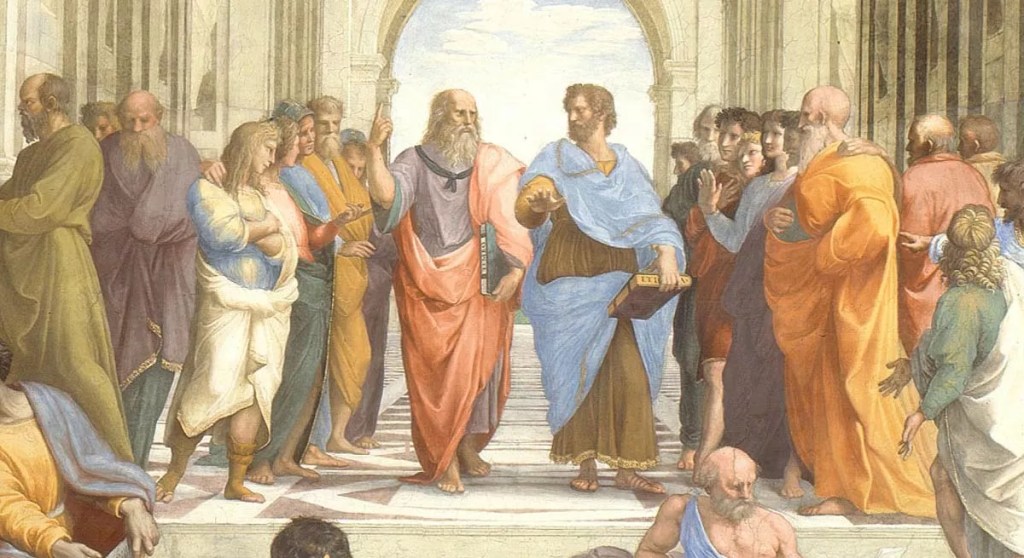
After the death of Socrates in 399 BCE, his student Plato (427–347 BCE) sought to preserve his mentor’s legacy—not through actions, but through ideas. He elevated Socratic questioning into a vast philosophical system, one that reached beyond the physical world.
Central to Plato’s philosophy was the notion of the world of forms—a timeless, unchanging realm where truth and perfection reside. In contrast, the material world was imperfect, fleeting, and ultimately illusory.
In his famous Allegory of the Cave, Plato likened human beings to prisoners chained inside a cave, mistaking the shadows on the wall for reality.
True knowledge, he argued, could only be attained by turning away from appearances and striving toward the light—toward the eternal truths beyond this world.
But such a journey, he warned, would be painful, disorienting, and deeply transformative.
Plato’s most gifted student, Aristotle (384–322 BCE), respected his teacher but did not follow him into the abstract heavens.
For Aristotle, the physical world was not a mere reflection of something greater—it was the reality. Meaning was not found in perfect forms, but in the everyday world of action, community, and purpose.
He believed that the good life—eudaimonia—was achieved through balance, moral virtue, and the fulfillment of human potential. It wasn’t about escaping the world, but living well within it.
A life shaped by reason, yes—but also by habit, responsibility, and participation in society.
Where Plato sought transcendence, Aristotle sought engagement. Both shaped Western thought for centuries to come.
Bridging Faith and Reason: The Medieval Synthesis
As the classical world gave way to a new religious era, philosophy did not disappear—it was transformed.
In the hands of Christian thinkers like St. Augustine (354–430 CE) and St. Thomas Aquinas (1225–1274 CE), the existential questions of Greek philosophy were reinterpreted through the lens of theology.
Augustine, a former skeptic turned passionate believer, wrestled with questions of sin, grace, and the restlessness of the human heart. His Confessions are less a system of philosophy than a deeply personal journey toward faith.
For him, the human condition was marked by longing—for truth, for meaning, for God.
“We are restless, until we rest in You.”
St. Augustine
Aquinas, centuries later, would take a more systematic approach. Influenced by Aristotle, he attempted to unite faith and reason into a coherent whole.
Humans, he argued, were both rational creatures and divine creations—capable of understanding the world through logic, but ultimately oriented toward a spiritual end.
In the medieval view, existence was not a random accident. It was part of a divine order.
The meaning of life wasn’t something to be created—it was something to be discovered through revelation, morality, and faith.
From Revelation to Doubt: The Birth of the Modern Self
The medieval worldview—anchored in divine order—held steady for centuries. But history does not stand still.
With the Renaissance came a rediscovery of classical thought, an explosion of art and science, and a growing focus on the individual. Human beings were no longer seen merely as souls on a journey to salvation, but as agents of knowledge, creation, and reason.
The rise of empirical science and the decline of ecclesiastical authority began to reshape the intellectual landscape of Europe.
The quest for meaning was no longer about interpreting God’s plan. It became a solitary search within the mind of man.
>>> Next Article : The Enlightenment
 Eksistensialisme.com