
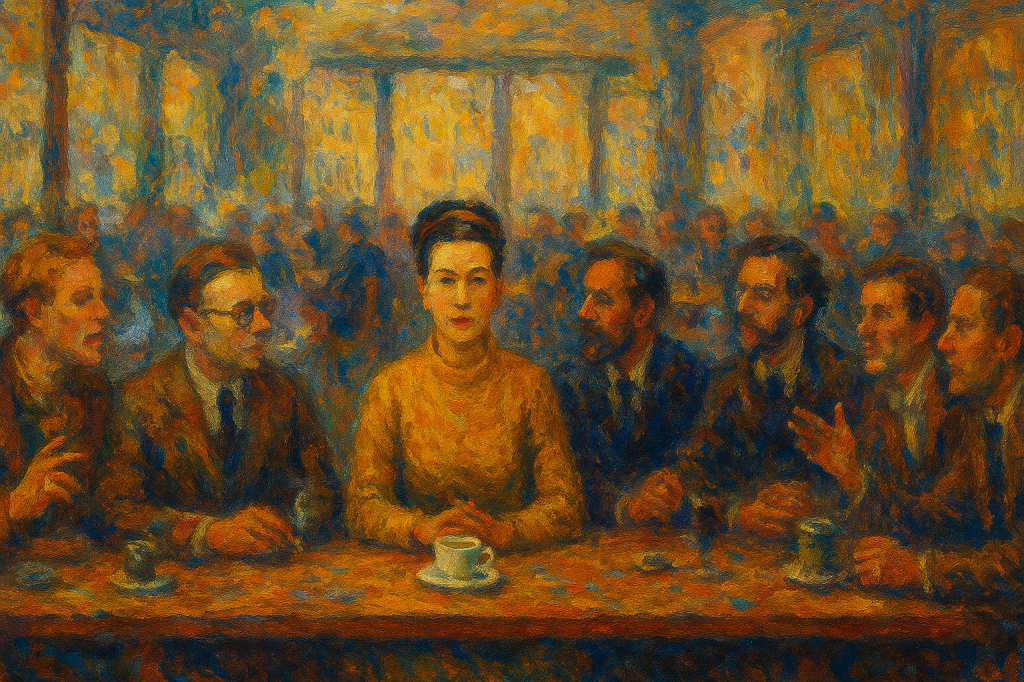
She stood apart in the smoke-laced cafés of Saint-Germain-des-Prés—not by accident, but by intent. While the men around her gestured wildly over espressos and abstractions, Simone de Beauvoir sat quieter, sharper, more alert—the only woman at the table, often, but never a footnote. In a world where brilliance was expected to wear trousers and a tie, she built one of the most radical philosophical visions of the 20th century—one that began not in theory, but in the lived experience of a woman in a man’s world.
On April 5, 1971, Simone de Beauvoir signed her name to a storm. Alongside 343 other women, she publicly declared that she had undergone an abortion—a criminal act in France at the time, punishable by years in prison. The manifesto, printed in the pages of Le Nouvel Observateur, did not beg for sympathy. It demanded change.
The act was defiant, deliberate, and intensely personal. But it was not impulsive. It came after decades of intellectual labor, lived experience, and philosophical reflection. It came from a woman who had spent her life questioning the roles assigned to her—by the Church, by the State, by men, by history—and choosing, always, to rebel.
Twenty years earlier, Beauvoir had already lit the fuse with her groundbreaking book Le Deuxième Sexe (The Second Sex), published in 1949. There, she took Hegel’s concept of the Other—the one defined only in relation to a dominant subject—and applied it ruthlessly to the history of women. Man was the standard; woman, the deviation. Man was the subject; woman, the object. And society had built itself around this lie.
To escape this trap, Beauvoir turned to the philosophy she helped shape: existentialism. If freedom is the core of human existence, then no woman could ever be completely imprisoned—because she always retains the ability to choose. Even a prisoner, she argued, can choose how to respond to the prison. And even a woman, shaped and silenced by history, can revolt.
But Beauvoir didn’t stop at theory. She made a sharp distinction between existential freedom—the freedom to choose—and practical freedom—the actual ability to act. A woman may be free in theory, but what good is that freedom if she lacks the right to control her own body, her own future?
The 1971 manifesto wasn’t just about reproductive rights. It was about the right to define oneself. It was the lived continuation of a philosophical project that had started decades earlier, in the cafés of Paris.
A Daughter in Revolt
Long before she became a fixture of Parisian intellectual life, Simone de Beauvoir was a girl with too many questions and too few acceptable answers. Born on a winter day—January 9, 1908—into a once-prosperous bourgeois family now facing financial decline, she grew up in a traditional Catholic household that would shape, then later provoke, her rebellion. Her father, though unable to provide a dowry—a social necessity for girls of her class—offered something far more valuable: access to literature, critical thought, and a belief in her intellect.
At fourteen, Beauvoir experienced a crisis of faith. The God her mother revered became, for her, a fiction. This rejection of religion marked her first act of philosophical defiance, setting the stage for a lifelong commitment to atheism, rational inquiry, and the pursuit of freedom.
One of the most formative influences on her early life was Élisabeth “Zaza” Lacoin. They met at nine and were soon inseparable—so much so that teachers dubbed them “the inseparables,” a term Beauvoir would later reclaim as the title of a novella about their friendship. Zaza embodied everything Beauvoir admired: intelligence, defiance, and a luminous individuality. But while Simone pursued independence, Zaza remained bound to the expectations of her conservative Catholic family.
Zaza’s life was marked by pressures to conform—especially around relationships and marriage. Eventually forced into an engagement she didn’t want, she spiraled into emotional turmoil. When she died at twenty-one, Beauvoir called it “an assassination by her environment.”
The loss devastated her. In Memoirs of a Dutiful Daughter, Beauvoir confessed how Zaza’s presence made her own thoughts feel “shapeless and without significance.” But it was in this painful contrast that she found the resolve to rebel—not only against her upbringing, but against the systems that shaped it.
Their friendship was as philosophical as it was emotional. Through Zaza, Beauvoir first confronted the tension between personal freedom and social constraint—a theme that would become foundational to her existentialist and feminist thought. Together, they resisted the rigid mold of bourgeois femininity. And yet, their bond was complex: marked by admiration, envy, and moments of self-doubt.
Zaza’s death was a turning point. Beauvoir never stopped trying to honor her memory. She fictionalized their relationship in The Inseparable—a novella written in 1954 but considered too intimate to publish during her lifetime. It wouldn’t be released until 2021. In that story, Beauvoir mourned not just her friend, but the possibility of a different life that society denied.
From that moment on, Beauvoir carried a moral imperative: no one should be sacrificed at the altar of conformity. Women must be free to define their lives—and society must be held accountable for the roles it imposes.
She took this conviction into the classroom. Pursuing philosophy, literature, and mathematics at the Sorbonne, she soon distinguished herself as a brilliant mind. In 1929, she became the youngest person ever to pass the agrégation in philosophy—a notoriously competitive examination that certified France’s top teachers. She placed second, just behind a man who had already failed it once: Jean-Paul Sartre.
A Free Spirit
Their meeting was electric. Sartre was audacious, brilliant, and, to some, insufferable. But Beauvoir saw in him a kindred spirit. Their relationship would span five decades and challenge every conventional notion of love. They were partners in thought, in politics, and in a shared rejection of bourgeois norms.
From the start, they agreed on a radical arrangement: they would be each other’s “essential love,” yet remain free to pursue “contingent” relationships. Fidelity, for them, meant honesty—not exclusivity. The pact, controversial even now, was less an act of rebellion than a lived expression of existentialist values: the freedom to choose, the refusal to possess.
“What we have is true love,” Sartre said, “but it is good to enrich our experiences.”
Yet the experiment was not without pain. Beauvoir’s affairs—with both men and women—were passionate, often profound. Her diaries reveal moments of private anguish: Sartre’s infidelities sometimes cut deeper than she let on, and the freedom they had both cherished could at times feel more like loneliness than liberation.
In a letter from 1947, she wrote to Sartre:
“No one has ever loved me as you do—or rather, no one has ever recognized me as you do… Still, there are times when I wish I could forget all the contingents and just belong to someone, entirely, without theory.”
That line carries the weight of contradiction—a longing for simplicity inside a love built on complexity.
Sartre proposed marriage once, hoping to secure shared state positions—a rare practical benefit. Beauvoir declined. Marriage, to her, was not just unnecessary; it was a concession to a system she had no intention of joining. She would not be anyone’s wife, not even his.
Their bond was not perfect, but it endured. The pact was never broken. She always returned—not because he fulfilled every emotional need, but because he was the one with whom she had built an entire way of life. A life rooted not in comfort, but in inquiry.
Together, they crafted a philosophy that embraced contradiction, rejected simplicity, and made room for the ambiguity of human relationships. Their love was not a surrender, but a question—posed again and again: What does it mean to choose? To commit? To remain free, even in closeness?
It was, in many ways, a philosophical experiment lived in the flesh.
As her relationship with Sartre deepened, so did her role in the Parisian intellectual scene. Though often the only woman in the room, Simone de Beauvoir was never out of place. She wore her hair in a simple chignon, dressed in long wool coats and practical shoes, and carried herself with a calm that unsettled men who were used to dominating conversation. She smoked constantly—Gauloises, unfiltered—and drank with ease. She debated fiercely, with no patience for pomposity. Her voice was measured, never shrill, but it cut through pretension like a scalpel.
In the cafés of Montparnasse and Saint-Germain-des-Prés, she held her own among the loudest, most opinionated men of postwar Paris—not by mimicking them, but by being unshakably herself. She was both insider and outsider: welcome at every table, but always aware of the assumptions she had to dismantle just to be taken seriously.
She once wrote, “I am incapable of belonging to anyone.” And yet, paradoxically, she belonged entirely to her convictions of freedom.
Beauvoir once recalled an evening in Paris, walking beside Sartre after a long argument—not about love, but about freedom. Sartre spoke of radical choice in abstract terms. She gestured to a homeless woman curled beneath the awning of a closed bookstore. “Even freedom,” she said quietly, “needs a place to sleep.” That night, she began sketching a vision of existentialism grounded not in theory, but in the raw texture of lived experience.
A Life of Ambiguity
While Sartre preferred abstract systems, Beauvoir turned to lived experience. Her writing—whether fiction, essay, or memoir—became a vehicle for philosophical reflection grounded in reality. She did not write philosophy in the traditional sense. She lived it, dramatized it, and exposed its consequences.
Her first major novel, She Came to Stay (1943), was a thinly veiled account of her entanglement with a younger woman. It explored themes that would become central to her work: desire, ambiguity, freedom, and the way we define ourselves in relation to others. The story was less about scandal than about consciousness—how one’s freedom collides with another’s, and how identity is always a negotiation.
She deepened these themes in The Blood of Others (1945), set against the backdrop of Nazi-occupied France. The novel grappled with moral responsibility during wartime, asking what it means to choose—and to be accountable—when others suffer as a result of our inaction. It marked Beauvoir’s first serious attempt to show how existential freedom must confront the weight of history, politics, and consequence.
But it was in The Ethics of Ambiguity (1947) that Beauvoir’s philosophical voice came into full clarity. This book marked a turning point. While she had long resisted being called a philosopher, here she laid out a moral framework that was not just inspired by existentialism, but distinctly her own.
She challenged Sartre’s notion of the human being as a “useless passion” by weaving in more optimistic strands from Heidegger—particularly the idea that humans don’t merely lack being, but also disclose it by making meaning in the world. At the center of her ethics was the concept of ambiguity: that we are both subject and object, both free and constrained, both individual and interdependent. For Beauvoir, ambiguity was not a problem to be solved—it was the human condition.
“To will oneself moral and to will oneself free are one and the same decision,” she wrote.
This line distilled a crucial shift in her thinking: freedom was no longer an abstract power to choose, but an ethical demand to take responsibility for what our choices mean in the world. She rejected moral systems built on absolutes and instead embraced an ethics of uncertainty—one that acknowledged our limitations but still called us to act.
Unlike Sartre, who often portrayed human relationships as inherently conflictual, Beauvoir believed in the possibility of authentic intersubjectivity. She argued that our freedom only becomes real when we affirm the freedom of others. Liberation, therefore, was not a solitary achievement but a collective project. As she wrote in The Ethics of Ambiguity,
“To will oneself free is also to will others free.”
This simple but radical idea became the cornerstone of her ethical vision: we do not find meaning alone—we build it together, in a shared and often unequal world.
Her work in Pyrrhus et Cinéas—an earlier, lesser-known essay—had already begun laying this groundwork. In it, she raised a set of existential questions: What goals are worth pursuing? What hopes are permitted to us? How should one live, given that life has no preordained meaning? She insisted that human beings must create their own purpose—but not in isolation. We always create in relation to others, and freedom without mutual recognition is incomplete.
This ethical vision would come to define Beauvoir’s mature philosophy: grounded in existential hope, fiercely aware of power, and determined to navigate ambiguity rather than erase it. It was a philosophy that rejected both divine authority and utopian abstractions. Instead, it called on individuals—especially women—to claim the right to define themselves, while also confronting the structures that shaped them.
And this, more than any single idea, would become the foundation of her most groundbreaking work.
The Age of Feminism
The culmination of decades of philosophical reflection, personal experience, and intellectual rebellion arrived in 1949, when Beauvoir published her magnum opus: Le Deuxième Sexe (The Second Sex). It was an unflinching, encyclopedic analysis of women’s condition—drawing from biology, history, psychoanalysis, literature, myth, and daily life. At its heart was a radical proposition:
“One is not born, but rather becomes a woman.”
With this single sentence, Beauvoir reframed gender—not as fate or biology, but as a process of social conditioning. Woman, she argued, is not a natural category but a historical construct—one that positions her as the Other in relation to man. In a world where man is the subject, the center, the ideal, woman is rendered the object, the deviation, the second.
Drawing from Hegel’s dialectic, Freud’s psychoanalysis, Marxist theory, and Sartrean existentialism, Beauvoir exposed how patriarchy operates not just through laws and institutions but through myths—myths of femininity, purity, maternity, and passivity. These cultural scripts taught women to internalize inferiority, to find value in being for others rather than for themselves.
But Beauvoir’s vision was not fatalistic. She insisted that women, like all human beings, possess existential freedom. Even under oppression, they retain the capacity to choose, to resist, to transcend the roles imposed upon them. The key was recognition—of the system, of one’s agency, and of the collective power to dismantle both.
When it was first published, The Second Sex caused an uproar. The Vatican banned it. Male critics dismissed it as obscene. Yet women across the world quietly passed it from hand to hand, reading in its pages the articulation of something they had long felt but never seen written so clearly. It transformed feminism from a political plea into a philosophical revolution.
Although its immediate reception in France was mixed, its influence expanded dramatically during the feminist movements of the 1960s and 1970s. It became the cornerstone of second-wave feminism—especially in the United States, the UK, and across Europe. Activists cited it as foundational in their demands for reproductive rights, workplace equality, and the reimagining of gender roles.
The Second Sex gave feminism a new vocabulary: the concept of gender as a social construct; the analysis of internalized oppression; the call to collective liberation rather than individual escape. Its impact rippled outward—not just in theory, but in lived struggle.
“The oppressor would not be so strong if he did not have accomplices among the oppressed,” she wrote.
From the late 1960s onward, women began to organize. Consciousness-raising groups, political marches, and manifestos took shape around the world. And though Beauvoir had not explicitly called for a mass movement in her book, her ideas helped birth one.
As her feminist voice grew stronger, so did her political involvement. She joined protests, wrote essays, and aligned herself with anti-colonial and leftist causes. During the Algerian War, she denounced French imperialism and torture. In 1971, she signed the Manifesto of the 343—a bold public declaration by women who had undergone illegal abortions in France, risking prison to challenge the law and demand reproductive rights.
She continued to write prolifically. In The Coming of Age (1970), she turned her gaze to another hidden realm: aging. Just as she had unmasked the myths of femininity, she now exposed how society renders the elderly invisible, treating them as burdens rather than subjects of their own stories. Again, her message was the same: what we take as “natural” is often just prejudice in disguise.
Her memoirs, including Memoirs of a Dutiful Daughter and The Prime of Life, are masterpieces of introspection. They are not simply autobiographical; they are philosophical reflections on how a consciousness is formed, how a woman constructs herself in a world that teaches her to disappear.
In The Second Sex, Beauvoir had already warned: “Representation of the world, like the world itself, is the work of men; they describe it from their own point of view, which they confuse with the absolute truth.”
And so, she rewrote the world. Not just for herself, but for those who came after.
A Refusal to Be Tamed
In the final years of her life, Beauvoir would sit for hours at Sartre’s grave in Montparnasse Cemetery. Sometimes with a book, sometimes in silence. Visitors would pass by, unaware that the woman in the coat and scarf had once redefined what it meant to be free.
When she died in 1986, she was buried beside him. But her legacy would not rest quietly underground.
Feminist scholars fought to secure her place in the philosophical canon. Long overshadowed by Sartre, she is now recognized as a foundational figure in both existentialism and feminist theory. Her ideas continue to shape contemporary debates about gender, identity, ethics, and politics.
She taught us that freedom is always embedded in context. That to live authentically is to take responsibility not just for one’s choices, but for their ripple effects. That gender is not destiny, but a project. That philosophy, if it is to matter, must be lived.
And yet, she remains a paradox. The woman who declared that one is not born but becomes a woman, also spent her life orbiting a man whose name eclipsed hers in history. She who championed women’s emancipation, often softened her brilliance so that his could shine. She who insisted on freedom, remained loyal to a pact that sometimes cost her joy. She who dared to live outside tradition, still carried wounds from the roles she once rejected but never entirely escaped.
Her life was not a straight line, but an unfolding. A refusal to settle. A commitment to becoming.
And in the quiet resistance of each choice she made—from rejecting God, to redefining love, to writing truth on her own terms—Simone de Beauvoir became not just a woman, but an idea.
She became herself.
Ambiguously. Defiantly. Completely.
 Eksistensialisme.com