A man lies dying in a small white room at Frederiks Hospital, Copenhagen. His body is thin, brittle, worn down by years of illness and restless thought. He looks more ghost than philosopher now—his skin pale, his limbs weak—but in his eyes, something flickers still: the defiant intensity of a man who has wrestled with angels. A friend sitting beside him asks if he is suffering. He smiles faintly. “No one suffers more than I do,” he says, “especially on purpose.”
Søren Kierkegaard was born on May 5, 1813, in Copenhagen—the seventh child of a wealthy but deeply troubled man. His father, Michael Pedersen Kierkegaard, was a devout Christian burdened by a private sense of guilt. He believed a sin in his youth had condemned his family. Five of his seven children died young, and Søren grew up under the shadow of a terrible conviction: that none of them, including himself, would live beyond the age of Christ—thirty-three.
It was a household haunted not only by death, but by anxiety. Melancholy ran through the Kierkegaard home like a bloodstream. Michael, though financially secure, spent his life reading theology and speaking in tones of eternal consequence. From a young age, Søren internalized the idea that life was a kind of divine test, that joy might be suspect, and that suffering was the price of seriousness.
Physically, Søren was weak and often ill. He was clever, even brilliant, but his sharp wit and barbed tongue made him an outsider at school. Where others socialized, he withdrew—into books, reflection, and private torment. Isolation, for Søren, was not just a condition. It was a calling.
The death of his mother, a quiet presence of comfort in an otherwise tense household, deepened his inwardness. When his father died in 1838, Søren—then twenty-five—found himself alone in the world, both financially independent and spiritually untethered.
But Søren did not run from suffering. On the contrary, he came to see it as the core of spiritual life—a crucible through which one could arrive at a deeper understanding of the self and a more intimate relationship with God. For Søren, spiritual existence was not a part of life—it was life itself. Salvation was not a theological abstraction but a personal quest, marked by anguish, solitude, and the silent labor of faith.
And it was precisely this view—that spiritual commitment must come before all else—that would come to define the most painful decision of his personal life.
The Woman He Loved, The Life He Refused
He met her when he was twenty-four. Her name was Regine Olsen—bright, cultured, full of life. Their relationship bloomed quickly. They fell in love, became engaged, and began planning a future together. For a brief moment, Søren tasted the kind of happiness that had always seemed distant to him—ordinary happiness, domestic, human.
And yet, something in him resisted.
As their bond deepened, Søren grew restless. He began to feel that to marry Regine would be a betrayal—not of her, but of a calling he could not ignore. He believed that a divine task had been laid upon his life, one that demanded solitude and suffering. Marriage, with its comforts and demands, would bind him to the world. It would pull him away from the inward path he felt destined to walk.
So he let her go.
He returned the engagement ring with a letter and vanished from her life. Regine, heartbroken and confused, came to his house to beg for an explanation—but he refused to see her.
Regine left a message behind, pleading with Søren not to leave her. Beyond her heartbreak, she feared that the end of their engagement would deepen his melancholia and tip him further into despair.
But Søren had already made his choice. Brilliant though he was, he struggled to form emotional bonds. He feared that marriage would tie him to the expectations of society—its roles, its rhythms, its quiet domesticity. What he longed for was solitude. What he needed, or believed he needed, was distance. And yet, he did not escape unscathed.
Yet, Regine had a profound influence on his philosophical views, as she remained an “essential subject” who continued to inspire his works throughout his life.
She was the one I loved. My existence must unconditionally accentuate her life. My writing should be considered a monument to her honour and memory. I carry her with me into history…
Kierkegaard on Regine Olsen
Either/Or: The Mirror of Choice
The heartbreak lingered, but Søren did what he always did with pain—he turned it into thought. In the months following the broken engagement, he sank deeper into solitude, walking the rainy streets of Copenhagen in long black coats, writing furiously in cafés and candlelit rooms. Out of this inward spiral came Either/Or (1843), his first major philosophical work and, in many ways, a veiled self-portrait.
At its core, Either/Or is not a treatise—it’s a confrontation. Through two pseudonymous voices—the aesthetic and the ethical—it explores the existential fork in every person’s life: should one live for pleasure or for responsibility? Should one float through life like a flâneur, or bind oneself to duty, to love, to God?
But Søren doesn’t offer a clean answer. He doesn’t tell the reader which path leads to salvation. Instead, he shows the weight of the choice itself—the agony of being forced to choose when no option guarantees happiness
“I see it all perfectly; there are two possible situations — one can either do this or that. My honest opinion and my friendly advice is this: do it or do not do it — you will regret both.”
Soren Kierkegaard, Either/Or: A Fragment of Life
Here is Søren at his most human—wry, tormented, and unflinchingly honest. What he offers is not a solution, but a mirror. Life, he suggests, is not about choosing the right answer, but about choosing, period—and bearing the consequence.
The personal is never far from the philosophical. Many have speculated that Either/Or is Søren’s way of reckoning with Regine. The aesthetic seducer Johannes in the text is charming, brilliant—and doomed by his own detachment. The ethical voice urges commitment, even when it hurts. Somewhere between these two masks lies Søren himself, still trying to understand the cost of his decision, still trying to make peace with it through thought.
But Søren wasn’t finished. Either/Or laid bare the dilemma of choice—but it still danced around the real terror: what happens when the choice itself defies all reason? When what we are called to do seems cruel, even unforgivable? That question haunted him, and it found its fullest expression in his next major work, Fear and Trembling.
Fear and Trembling: Leap into the Unknown
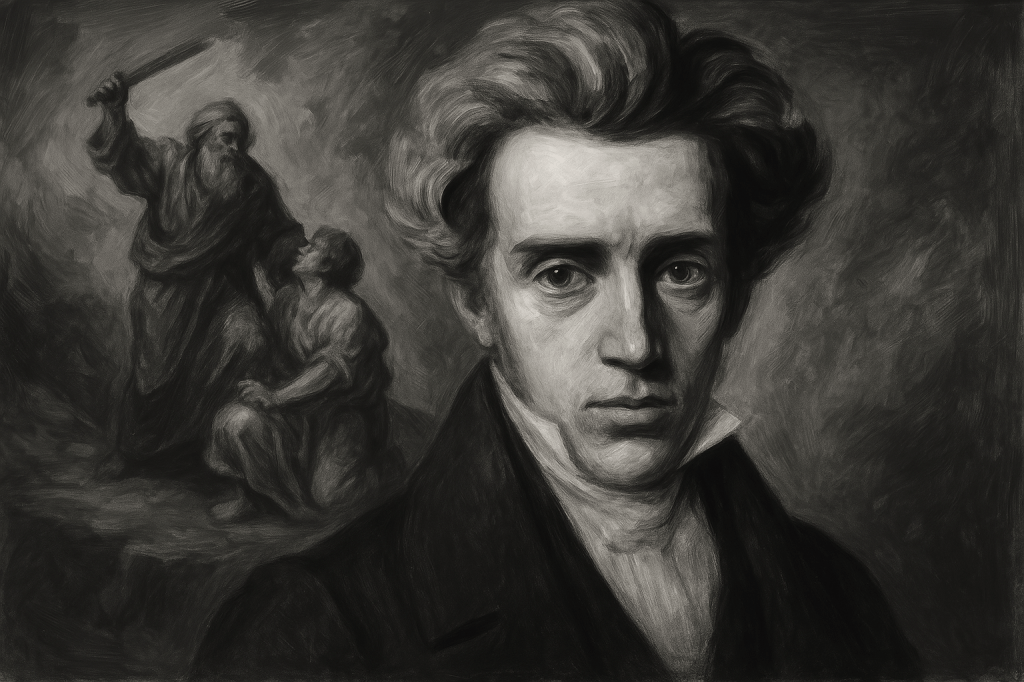
Published just months after Either/Or, the book returns again and again to a single biblical story: Abraham, commanded by God to sacrifice his only son, Isaac.
For Søren, this was no parable. It was a real psychological and spiritual crisis. How could Abraham do it? How could he raise the knife, walk three days with his son, lie to his wife, and keep his faith intact? Søren was not interested in the miracle that stopped the blade—he wanted to understand the terror that preceded it. The silence. The isolation. The impossible trust.
This, he believed, was the image of true faith—not obedience, but dread. Not certainty, but absurd conviction.
And beneath the theology, Søren was writing about something else—something closer. Many have read Fear and Trembling as an attempt to justify, or at least understand, his decision to leave Regine. In Abraham’s anguish, Søren saw a reflection of his own. Just as Abraham was asked to give up what he loved most in the world, Søren believed he too was called to a sacrifice: not because he didn’t love Regine, but because he did.
“To be able to lose the whole of temporality and gain eternity is what makes a knight of faith,” he wrote.
For Søren, leaving Regine was not cowardice—it was his leap of faith. A calling that only he could hear, one that no one else could possibly understand. Like Abraham, he could not explain himself. He could not defend his choice. And that, for him, was the very definition of faith: not clarity, but trembling. Not logic, but a solitary trust in the absurd.
It was a devastating idea—that faith might demand the impossible, and that love might require its own crucifixion. But Søren embraced it. Because in his view, only by walking into the silence—into the madness of divine calling—could one truly be free. Only there could one become what he called “the knight of faith.”
In Fear and Trembling, Søren does more than wrestle with Abraham’s story—he draws a radical philosophical line. What Abraham embodies, he argues, is a person who places individual faith above universal ethics. The moral law says you must not kill. But Abraham listens to something deeper—something personal, divine, and entirely incommunicable.
This is the unsettling core of Søren’s thought: that in the most decisive moments of life, the individual must stand alone. Not against morality, but beyond it. Not to dismiss ethics, but to reveal that human existence cannot always be contained by universal rules. The real self, he insists, is not defined by systems or categories—but by the choices it makes in isolation.
If anyone on the verge of action should judge himself according to the outcome, he would never begin. Even though the result may gladden the whole world, that cannot help the hero; for he knows the result only when the whole thing is over, and that is not how he became a hero, but by virtue of the fact that he began.”
Kierkegaard on Fear and Trembling
It was a rejection of Hegelian philosophy, which viewed human beings as expressions of a larger rational system, a cosmic totality unfolding through history. Søren couldn’t accept that. For him, no historical system could account for the anguish of standing before a choice that no one else could understand. No grand narrative could explain the torment of leaving Regine. No philosophy of the universal could tell him what to do with a trembling heart.
From this insight emerged a profound shift: the idea that subjective truth—what we believe, what we suffer, what we choose—matters more than objective systems. That human existence begins not in abstract reason, but in lived experience.
This is the spark that would ignite existentialism.
Long before the term existed, Søren had carved its path: the individual over the universal, the leap over the system, the self over the structure. He believed that to truly live, one must not merely follow—but choose. Not just believe—but commit. And in doing so, accept the full weight of freedom, anxiety, and the impossible demand of being oneself.
Christian Against Christendom
This radical emphasis on the individual didn’t just set Søren apart from philosophers—it put him in direct conflict with one of the most powerful institutions of his time: the Church.
For Søren, Christianity had lost its soul.
The Danish Lutheran Church, tightly woven into the fabric of society, had become what he called Christendom—not a living faith, but an empty structure of rituals, doctrines, and respectability. In his view, the Church no longer nurtured a relationship with God; it managed conformity. Faith had become a ceremony. Morality had become manners. And salvation, a social assumption.
Søren would have none of it.
To him, true faith was a deeply personal struggle—an intimate confrontation between the individual and the divine, filled with dread, silence, and solitude. No priest could mediate it. No liturgy could contain it. The idea that one could be a Christian by birth, by habit, or by tradition was, for Søren, a kind of blasphemy.
Religion, he believed, must be chosen again and again, in anguish and awareness. It was not a collective identity—it was a solitary walk.
This stance led to his fiercest writings: direct attacks on the institutional Church, its clergy, and its comfortable gospel. He accused them of serving culture rather than Christ, of flattering the public instead of calling them to repentance. In one of his final publications, The Moment, he wrote with the sharpness of a prophet and the pain of a man utterly alone in his convictions.
What the Church feared most, he gave them: a Christian who took Christ seriously.
His relentless critique earned him the scorn of religious authorities and isolated him even further from polite society. But it also solidified his legacy—not as a theologian, not as a rebel, but as a thinker who insisted that faith must be lived, not inherited.
To follow Christ, Søren argued, was not to follow doctrine. It was to walk into the unknown, trembling—but free.
A Life Lived Forward
In the early autumn of 1855, Søren stood on Bredgade Street in the heart of Copenhagen, handing out copies of his self-published journal The Moment to passing strangers. With the intensity that had never left him, he spoke to anyone willing to listen—about love, about faith, about a kind of Christianity he believed had long been forgotten.
Then, without warning, he collapsed on the sidewalk.
He never fully recovered.
A few weeks later, Søren died at the age of 42—ten years beyond the limit his father once believed none of his children would surpass. Despite the fierce opposition he held toward the official Church, his funeral was held at Copenhagen’s main cathedral. The very institution he had battled offered a place for his body, even if not fully ready to carry the weight of his spirit.
At the time of his death, Søren’s writings were controversial, difficult, and widely misunderstood. His frequent use of pseudonyms had made his identity as a thinker difficult to pin down, and many dismissed him as an eccentric recluse, more preacher than philosopher.
But over time, something shifted.
By the early 20th century, Søren was being read anew—not as a theological oddity, but as a pioneer. His writings on despair, anxiety, individuality, and the leap of faith resonated in a modern world increasingly unsure of itself. He spoke to those who had lost their certainty, but not their longing. To those for whom faith, if it could still be found, must come through doubt—not around it.
He became, retroactively, the first existentialist.
His life was not one of comfort, nor popularity, nor resolution. But it was lived with staggering clarity. Every thought was hard-won. Every choice a burden. And yet through it all, Søren remained committed to the belief that truth—if it was to matter—must be lived.
One is to believe what isn’t true; the other is to refuse to believe what is true. The most common form of despair is not being who you are. It is perfectly true, as philosophers say, that life must be understood backwards. But they forget the other proposition, that it must be lived forwards.
The Diary of Soren Kierkegaard
The year 1843 marked a turning point—not only in Søren’s life, but in the birth of a new philosophical current. Just two years after he ended his engagement to Regine, he published Either/Or and Fear and Trembling, two works that would quietly lay the groundwork for what would later be called existentialism. And then, as if history had already prepared its reply, the following year—1844—a child was born in Germany. He would become the philosopher who took Søren’s torch—and set it to the heavens, not just to question religion, but to confront God Himself.
References:
 Eksistensialisme.com