What cosmic insignificance taught us about meaning, responsibility, and the fragile wonder of being human.
It began with a question.
Not a loud one, not the kind that echoes across lecture halls or interrupts dinner conversations. But a quiet, unsettling question that arrives uninvited—somewhere between a sleepless night and the stillness of a starry sky:
Does any of this mean anything?
Zoom out far enough, and the answer seems obvious.
The Earth is a speck—less than a whisper in the endless breath of the cosmos. Our entire species, from ancient cave paintings to space telescopes, is sandwiched between two unknowable voids: the past that forgot us, and the future that won’t remember.
Thirteen point eight billion years of cosmic history, and we—hairless primates on a small, rocky planet—have existed for a flicker. Not even a full second in the life of the universe.
So what’s the point?
For a while, the answer came easy.
To early humans, the world felt made for us. The Earth spun at just the right distance from the Sun, warm enough to cradle life, cool enough to keep it breathing. Rain fell, crops grew, animals roamed. The stars drew patterns in the sky, and the moon lit the path home. It all felt intentional. As if the universe had been waiting for us to open our eyes.
But knowledge, like fire, doesn’t just illuminate—it burns.
With every telescope pointed skyward, every equation scribbled onto a chalkboard, the illusion unraveled. We are not at the center. Not of the solar system. Not of the galaxy. Not of anything.
Ours is one planet among billions. One galaxy among trillions. A blink. A coincidence.
Worse still—nature didn’t need us.
Four billion years passed before we arrived, and the Earth spun on. Dinosaurs ruled for a hundred million years and left no trace of regret when they vanished. One day, we too will be gone, and the Earth may hardly notice.
And even Earth will die.
Six billion years from now, the Sun will swell and consume the inner planets. And our solar system—this tiny neighborhood we call home—will vanish into silence. And yet, the universe will still be young. Stars will still be born. New galaxies will bloom. The cosmic story will go on… without us.
So again: Does any of this matter?
Somewhere between despair and wonder lies the truth.
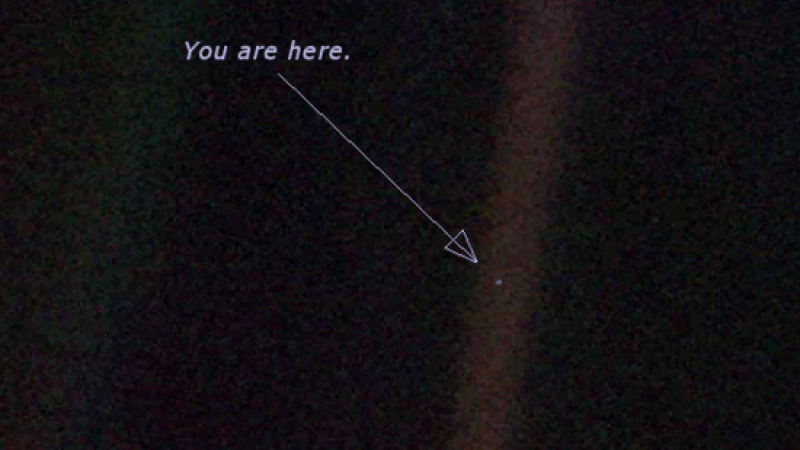
In 1990, the Voyager 1 spacecraft—launched in 1977—was about to leave the solar system. Before its final departure, NASA turned its camera back toward home.
What it captured would become an icon of cosmic humility:
A single pixel. A faint, pale blue dot. Suspended in a shaft of sunlight. Adrift in infinite darkness.
Carl Sagan, who helped imagine that photograph, later wrote:
Pale Blue Dot
“Look again at that dot. That’s here. That’s home. That’s us. On it everyone you love, everyone you know, everyone you ever heard of, every human being who ever was, lived out their lives.
The aggregate of our joy and suffering, thousands of confident religions, ideologies, and economic doctrines, every hunter and forager, every hero and coward, every creator and destroyer of civilization, every king and peasant, every young couple in love, every mother and father, hopeful child, inventor and explorer, every teacher of morals, every corrupt politician, every ‘superstar,’ every ‘supreme leader,’ every saint and sinner in the history of our species lived there—on a mote of dust suspended in a sunbeam.”
“The Earth is a very small stage in a vast cosmic arena. Think of the rivers of blood spilled by all those generals and emperors so that, in glory and triumph, they could become the momentary masters of a fraction of a dot.
Think of the endless cruelties visited by the inhabitants of one corner of this pixel on the scarcely distinguishable inhabitants of some other corner, how frequent their misunderstandings, how eager they are to kill one another, how fervent their hatreds.
Our posturings, our imagined self-importance, the delusion that we have some privileged position in the Universe, are challenged by this point of pale light.
Our planet is a lonely speck in the great enveloping cosmic dark. In our obscurity, in all this vastness, there is no hint that help will come from elsewhere to save us from ourselves.
The Earth is the only world known so far to harbor life. There is nowhere else, at least in the near future, to which our species could migrate. Visit, yes. Settle, not yet. Like it or not, for the moment the Earth is where we make our stand.
It has been said that astronomy is a humbling and character-building experience. There is perhaps no better demonstration of the folly of human conceits than this distant image of our tiny world.
To me, it underscores our responsibility to deal more kindly with one another, and to preserve and cherish the pale blue dot, the only home we’ve ever known.”
The Answer Isn’t in the Stars—It’s Here
There is no script waiting in the stars.
No meaning descending from the galaxies.
The cosmos doesn’t owe us purpose.
But we are aware. We are conscious. We ask. And perhaps that’s enough.
The Pale Blue Dot isn’t a reminder of our insignificance.
It’s a reminder of our potential.
That meaning isn’t something we find—but something we write.
In the margins of our lives. In the care we show. In the future we shape.
Yes, we are made of stardust.
But more miraculously—we are stardust that thinks.
And for now, we are here.
On this fragile dot.
Suspended in light.
So the real question is no longer cosmic.
It’s human:
What will you do with your moment?
 Eksistensialisme.com
Leave a comment