After years of isolation, crisis, and digital overstimulation, the sense that life has lost its meaning has become a quiet undercurrent of modern life. But recently, in the most unlikely corner of the internet, something different began to emerge. Not naive optimism, but a kind of radical defiance—a belief that even in the face of absurdity, hope still has a place. This is the story of how a generation raised on irony and existential dread began to rediscover meaning through an algorithm built for distraction.
Zaid Khan spent most of his life online. Like many of his generation, he considered himself an optimist—but even optimism can erode when fed a constant stream of digital despair. “I think that’s just a very easy rabbit hole to fall down when you’re using the internet,” he said. “Feeling like, ‘Oh my god, everything sucks. We’re all doomed.’”
But toward the end of 2022, something unexpected began to trend on TikTok. Under hashtags like #hopecore and #antinihilism, a new wave of content emerged—one that offered not escapism, but a kind of radical optimism. It took many forms: video game clips, sports montages, tweets turned into slideshows, snippets of web comics, and strangers speaking directly into the camera with trembling sincerity.
In one video, someone responds to the phrase “I hate my life” with a quiet counterpoint: “All my homies rejoice in the day the Lord has made.” In another, a man stares into the lens while a quote from Albert Camus appears over his shoulder: “In the depth of winter, I finally learned that within me there lay an invincible summer.” The comments flood in. “This is seriously helping me since it’s been really rough lately,” one writes. “We’re all going to make it,” says another.
In November, Zaid Khan added his voice to the movement. He uploaded a 14-second clip of his own—a soft piano melody he composed, layered with gentle affirmations and a simple caption: “Resist the dread.” It was the first in what would become a series of “anti-nihilism” TikToks that quietly reached tens of thousands of viewers.
Today, the hashtag #hopecore has surpassed 700 million views. It overlaps with adjacent movements like #hopeposting, #optimisticnihilism, and newer trends like #webweaving and #positiveslideshows.
Perhaps what makes this movement resonate isn’t that it ignores suffering—but that it meets it head-on. Unlike toxic positivity, which denies the darkness with shallow smiles, this new genre embraces the tension between despair and defiance. It stages an epic battle between “the indomitable human spirit” and “the indifferent cruelty of the universe”—often set, fittingly, to the sound of Coldplay’s “Viva La Vida.”
You don’t have to be fluent in philosophy to feel what’s happening here. But if you were, you might notice this: Gen Z is inching away from nihilism and toward something more existential. Figures like Franz Kafka and Albert Camus are trending again—not as dusty thinkers, but as voices that feel eerily aligned with the post-COVID world. Their ideas aren’t cheerful, but they’re honest. They admit life is hard and absurd, but insist it’s still worth engaging with. That meaning isn’t found, it’s made—and that maybe, just maybe, it can be beautiful.
What Is Nihilism, Really?
Before we can understand the rise of anti-nihilism, we need to understand what it’s pushing against.
Nihilism, at its core, is the belief that life has no inherent meaning or value. That the universe was not made with purpose, and that our existence—no matter how sentimental we make it—will eventually dissolve into nothing. No divine plan. No cosmic justice. No reason why.
It’s not just a mood. It’s a worldview.
The term was first coined by the German philosopher Friedrich Jacobi in the late 18th century, but it gained cultural weight through the writings of Friedrich Nietzsche. In his diagnosis of modern Europe, Nietzsche observed a growing crisis: with the decline of religion, humanity was losing its oldest source of meaning. What remained was a terrifying vacuum. Science could explain the “how,” but not the “why.” And without a framework to understand suffering, life itself began to feel empty.
“Nihilism appears at that point,” Nietzsche wrote, “not because the displeasure of existence has grown, but because one has come to mistrust any ‘meaning’ in suffering… it now seems as if there is no meaning at all in existence, as if everything were in vain.”
Online, Nietzsche is often miscast as the brooding father of despair—a grim icon quoted by teenagers in existential crisis or superimposed over grayscale aesthetics. But if you read him closely, you’ll find the opposite: Nietzsche wasn’t celebrating nihilism. He was warning us.
Yes, he declared that “God is dead,” but not with triumph. It was a diagnosis of cultural decay—the moment when old structures collapsed, leaving nothing but uncertainty in their place. Without religion, tradition, or universal truths to fall back on, Nietzsche saw modern man drifting. Disoriented. Unmoored.
But to Nietzsche, nihilism wasn’t the end. It was a threshold.
He believed we could respond to the loss of meaning in two ways. The first was what he called passive nihilism—a resignation to despair, detachment, or escapism. It’s the retreat into apathy, the belief that if life has no meaning, then nothing matters.
The second path was far more daring: active nihilism. The courage not only to face the void, but to build something new inside it. Nietzsche imagined a person who, upon realizing the universe offers no inherent meaning, chooses to become the author of their own values—a creator of meaning rather than a victim of its absence.
“Man is a rope,” he wrote, “tied between beast and Overman—a rope over an abyss.”
For Nietzsche, the solution to nihilism wasn’t to mourn the absence of meaning—it was to become strong enough to carry that absence, and still choose to live.
Far from a prophet of doom, Nietzsche was among the earliest thinkers to point toward something that would later take shape in a different form: existentialism.
From Nihilism to Existentialism: A Way Forward
If nihilism is the recognition that life has no given meaning, then existentialism is what comes after—the decision to live anyway.
It was the French philosopher Jean-Paul Sartre who gave existentialism its most famous expression: “Existence precedes essence.” In other words, we are not born with a prewritten purpose. We arrive first—confused, conscious, and painfully free—and only afterward do we begin to define who we are.
This idea might sound simple, but it’s radical. It places the burden of meaning not on God, not on fate, not on society—but on the individual. In a world stripped of objective purpose, we are the ones who must create it.
Where nihilism stops at the void, existentialism walks into it.
Sartre, along with Simone de Beauvoir and Albert Camus, believed that human beings are capable of transforming that nothingness into something deeply personal. Through choice, through action, through responsibility—we shape the meaning of our lives.
But it’s not easy. Sartre famously described this condition as a kind of curse: “Man is condemned to be free.” Condemned, because there’s no instruction manual. No map. Only the dizzying freedom to choose, and the equally heavy responsibility to own what we choose.
For many, especially those growing up in the digital haze of late capitalism, this can feel overwhelming. If everything is meaningless, then where do we begin?
And yet, the answer offered by existentialism is surprisingly simple: we begin anywhere. In love, in art, in kindness, in defiance. In the very act of choosing to care—even when there’s no cosmic reason to.
A Personal Awakening: Choosing Meaning
Strangely, quietly, it seems the TikTok generation has stumbled upon existentialism—not through books or lectures, but through shared emotional fatigue. After years of irony, detachment, and doomposting, something shifted. Not into blind optimism, but into something softer, stranger, and more resilient: hope with full knowledge of despair.
Videos tagged #hopecore, #optimisticnihilism, or #antinihilism don’t deny how bleak the world can be. In fact, they begin there. What makes them radical is that they don’t stop there. They acknowledge the absurdity of life—and still urge you to get out of bed. They quote Camus in between memes, overlay Nietzsche with lo-fi beats, and turn Sartre into an aesthetic. This is not philosophy as authority—it’s philosophy as survival.
What makes it meaningful isn’t how “deep” the content is, but how deeply it resonates. These videos say: You’re not alone in feeling lost. But being lost doesn’t mean you’re broken. It means you’re alive.
It’s not about pretending everything is okay. It’s about learning to live in the tension: between dread and defiance, between collapse and creation. And in that strange middle space, meaning begins to emerge—not as something found, but as something built.
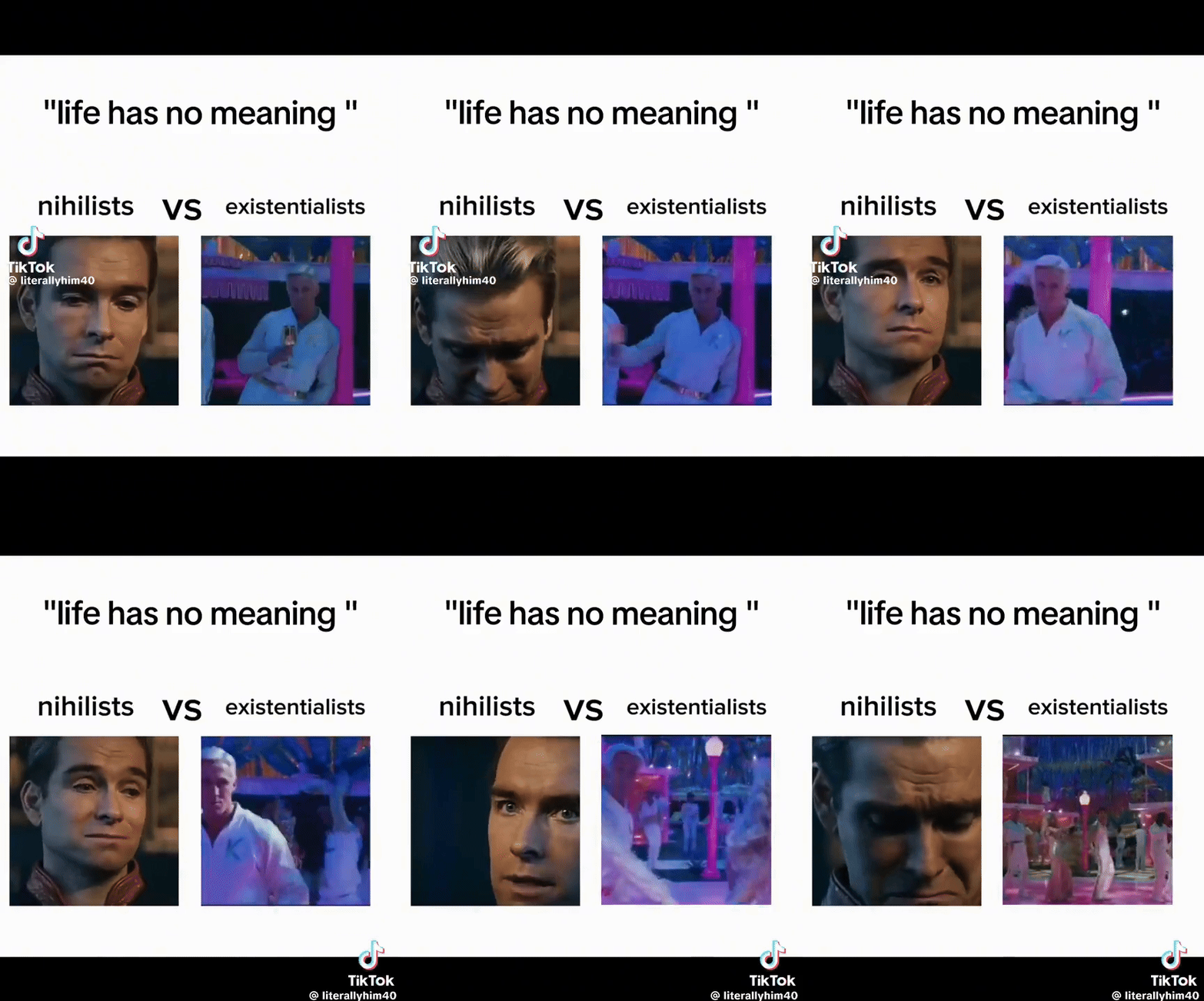
For Zaid Khan, that shift from nihilism to existentialism wasn’t just intellectual—it was transformative. As 2022 gave way to 2023, something in him changed. The dread hadn’t disappeared. The absurdity of the world hadn’t lessened. But the way he related to it had.
“I definitely had this awakening or revelation in the past few months,” he said, “that life is very short. And I feel like we all owe it to ourselves—if we have the means—to really explore more of our passions and more of what we actually care about.”
So he made a choice. He quit his full-time job and began focusing on music, recording an alt-pop album in his home studio. It wasn’t a leap into certainty. It was a step into meaning—a deliberate act of authorship in a world that offers none by default.
And that, in the end, is what existentialism demands. Not that we deny the darkness, but that we respond to it. Not that we fake joy, but that we commit to the act of creating joy where we can, even in fragments.
Khan’s story isn’t unique. That’s what makes it powerful. It’s one of thousands quietly emerging across platforms, cities, and private lives—a generation choosing to participate, to feel, to try, even when nothing guarantees that it’s worth it.
Because maybe worth is something we don’t find.
Maybe it’s something we make.
The Invincible Summer
Philosophy doesn’t always come in leather-bound books. Sometimes, it comes in 14-second videos. In lo-fi edits. In strangers whispering hope into a screen. And sometimes, it arrives not to answer our questions, but to remind us we’re not the only ones asking them.
The resurgence of existentialism in digital spaces is not an escape from reality—it’s a refusal to let reality flatten us. In a time when despair has become ambient noise, choosing to feel, to care, to build meaning anyway is a deeply human act.
Albert Camus, perhaps the most poetic of the existentialists, once wrote:
“In the depth of winter, I finally learned that within me there lay an invincible summer.”
That’s the heart of this quiet rebellion.
We are not guaranteed clarity. We are not promised meaning. But we are here, conscious, absurdly alive, with just enough time to turn even our smallest choices into something beautiful.
Hope, then, is not a delusion.
It is a discipline.
Youth is happy because it has the capacity to see beauty. Anyone who keeps the ability to see beauty never grows old.
Franz Kafka
 Eksistensialisme.com
Leave a comment