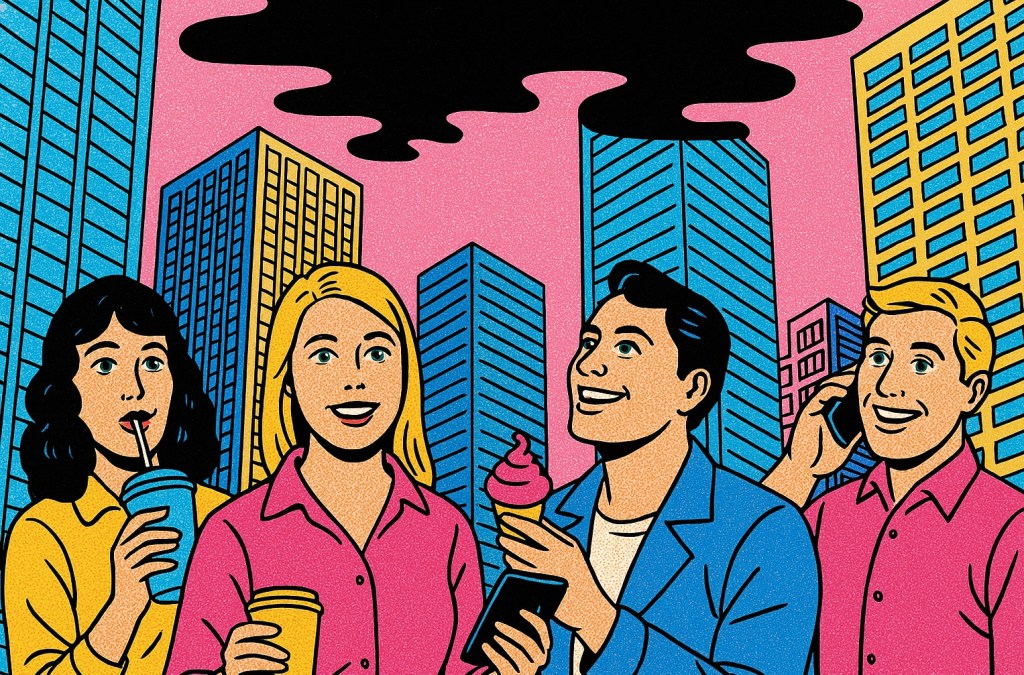
The world’s stable now. People are happy; they get what they want, and they never want what they can’t get.” That line wasn’t pulled from a startup pitch deck. It’s from Brave New World—a dystopian novel from 1931. And disturbingly, it’s beginning to sound a lot like now.
Most people still fear a future that looks like 1984—a world ruled by surveillance cameras, propaganda, and brute force. George Orwell gave us that nightmare: a government that watches everything, controls language, and punishes even a stray thought.
But Aldous Huxley, Orwell’s former French teacher, envisioned something far more seductive—and far more difficult to resist.
When 1984 was first published and stirred public imagination, Huxley reportedly sent Orwell a letter. “You know, George,” he wrote, “your dystopia is powerful. But do you really believe totalitarian rule will come with boots and guns? I think it will arrive with comfort, not violence—with people so pleased by their distractions that they forget to care about freedom at all.”
In Brave New World, there are no secret police. There’s no fear of punishment. People are happy, not because they are free, but because they’ve been conditioned to want only what they can have—and to never desire anything deeper.
The masses are not controlled by pain, but by pleasure. Not through censorship, but through saturation. Not by fear, but by fulfillment.
And nearly a century later, Huxley’s imagined future feels less like science fiction—and more like a description of the present.
The Science of Compliance: From Lab Rats to Citizens
In the mid-20th century, psychologist B.F. Skinner ran a series of experiments that would quietly reshape how we think about behavior. His test subjects were rats and pigeons. His tools were levers, lights, food pellets, and electric shocks.
Skinner discovered something profound: punishment can suppress behavior, but it rarely erases it. Fear can stop a rat for a moment, but the desire remains. Pleasure, however—pleasure rewires.
When a reward is given in response to a desired action, that behavior becomes stronger, more frequent, more natural. Over time, the subject doesn’t even realize it’s being conditioned. It simply keeps pressing the lever. Again and again.
Aldous Huxley didn’t need surveillance to build his dystopia—he needed only this insight. That people don’t need to be forced if they can be trained to love their servitude.
In Brave New World, this insight becomes political. Citizens are conditioned from birth not just to obey, but to desire what the system provides. Rebellion isn’t suppressed. It’s rendered irrelevant.
It seems to me that the nature of the ultimate revolution with which we are now faced is precisely this: That we are in the process of developing a whole series of techniques which will enable the controlling oligarchy who have always existed and will always exist to get people to love their servitude.”
Aldous Huxley, Brave New World Revisited.
And the most effective form of control, it turns out, doesn’t look like control at all.
The Age of Soma and Infinite Distraction
Today, we don’t have Soma. We don’t need it.
In Huxley’s world, obedience isn’t enforced with violence—it’s administered with Soma. A miracle drug, always within reach. In small doses, it soothes anxiety. In large doses, it delivers blissful hallucinations. But its most important function? It keeps people happy enough not to question anything.
Although the idea of mind control may sound like science fiction, by the mid to late 20th century, an increasing number of philosophers, psychologists, and scientists began to agree with Huxley’s warnings: the foundations for such a system were already being studied. In 1953, British philosopher Bertrand Russell cautioned that advances in physiology and psychology were enabling governments—especially in liberal democracies—to exert far greater control over individual mentalities than ever before. And crucially, he warned, this control was not just a future threat. It was already happening.
I believe that too few people are aware of the extent, the breadth, and the depth of the advances which have been made in recent decades in the behavioral sciences…the increasing power for control which it gives will be held by some one or some group; such an individual or group will surely choose the purposes or goals to be achieved; and most of us will then be increasingly controlled by means so subtle we will not even be aware of them as controls…it appears that some form of completely controlled society…is coming
Bertrand Russel
Today, we don’t have Soma. We don’t need it.
We have notifications. Streaming platforms. Mood
We have notifications. Streaming platforms. Mood stabilizers. Filters that soften reality and algorithms that sharpen our cravings. We carry entire libraries of distraction in our pockets—each swipe, each scroll, a tiny dose of pleasure, a minor escape from the present.
It’s not that any of these things are evil. Pleasure is not the enemy. But when comfort becomes constant, when stimulation is always one click away, we begin to lose our tolerance for silence, for discomfort, for reality itself.
We become conditioned—not by force, but by choice. A thousand small choices made every day, often without thinking: to scroll instead of sit, to binge instead of reflect, to numb instead of feel.
And somewhere along the way, freedom becomes harder to define. Not because it was taken from us. But because we stopped remembering what it felt like to need it.
The Danger of Happy Slaves
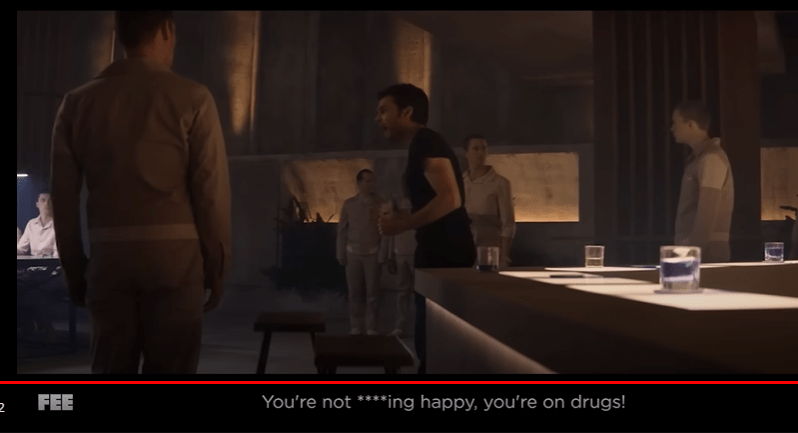
What if the perfect dystopia is one where no one wants to escape?
That was Huxley’s ultimate warning. In Brave New World, the system doesn’t need to silence dissidents—because there are none. Why rebel when you’re comfortable? Why question when you’re entertained? Why fight for freedom when you’ve forgotten what it’s for?
In a world engineered for pleasure, submission becomes voluntary. People are not coerced—they’re content. They don’t cry out for freedom, because they’ve been trained to equate discomfort with failure, and compliance with happiness.
Huxley feared this more than Orwell’s vision of oppression. Not a world of terror—but a world of tranquil apathy.
A society where citizens are so pacified by convenience, so medicated by comfort, that they come to love their chains. As he later wrote in Brave New World Revisited:
“The ultimate revolution… will enable the ruling oligarchy to get people to love their servitude.”
In such a world, slavery isn’t enforced—it’s embraced. And when a slave becomes a happy slave, as Frederick Douglass once wrote, he has lost not only his freedom, but the very sense that he is supposed to be free.
Freedom, Discomfort, and the Human Condition
Freedom is not easy. It’s messy, uncertain, and often painful. It demands that we make difficult choices, carry the weight of responsibility, and live without guarantees. It does not promise happiness—but it offers something deeper: the right to define what happiness means.
This is why freedom matters. Not because it makes life comfortable, but because it makes life ours.
Comfort, on the other hand, is seductive. It whispers promises of ease, of smooth edges, of a life without pain. And yet, when comfort becomes constant, it begins to blur into control. We stop asking questions. We stop seeking truth. We stop remembering what it meant to be fully alive.
Psychoanalyst Sigmund Freud called this the pleasure principle—the human instinct to pursue pleasure and avoid pain. But he warned that the real world always disrupts this instinct. Reality intrudes. And so we learn to compromise, to balance pleasure with meaning.
But what happens when we stop balancing? When our pursuit of happiness becomes so relentless, we outsource the work of meaning itself?
Then we become manipulable. Not through fear, but through craving. And those who offer comfort gain the power to shape not just what we do, but who we are.
“The goal towards which the pleasure principle impels us—of becoming happy—is not attainable: yet we may not, nay, cannot, give up the effort.”
—Sigmund Freud
The danger isn’t that we’ll be forced to surrender freedom. It’s that we’ll give it up willingly—for a hit of dopamine, for distraction, for peace.
And when that happens, the question isn’t whether we’re still free.
The question is whether we’re still human.
The Future We Choose
Maybe the world is stable now. Maybe people are happy.
But if Huxley was right, then the danger lies not in what we suffer—but in what we welcome without resistance.
So ask yourself: are we living in the world Orwell feared, or the one Huxley described?
And if it’s the latter—will we even notice?
Because comfort can silence dissent, and pleasure can dim the urge to question. But somewhere within us still burns the uneasy truth: we were not made for cages, no matter how soft the walls.
So perhaps the real test of our time is not whether we are entertained, or connected, or fulfilled.
But whether we are still free enough to want something more.
To choose.
To resist.
To feel discomfort.
To be fully human—especially when it would be easier not to be.
Perhaps the forces that now menace freedom are too strong to be resisted for very long. It is still our duty to do whatever we can to resist them.
Aldous Huxley
 Eksistensialisme.com
Leave a comment