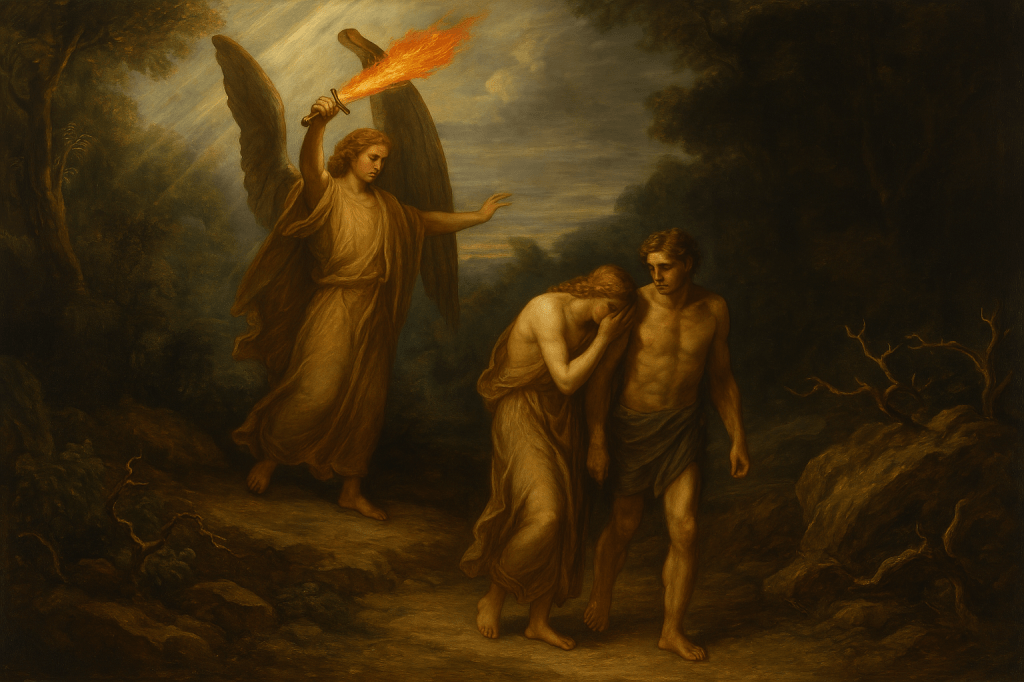
And so, they ate. There was no divine rupture—no thunder, no tearing of heaven—only the quiet awakening of eyes. They found themselves naked, fragile, and alone beneath a sky that no longer looked like home. In the stillness that followed, God came walking in the garden. Then, with no joy and no second chances, He cast them out. At the edge of Eden, where rivers once flowed in peace, now stood angels—terrible and silent—wielding flaming swords, sealing the gate with fire. The way back was closed. Forever.
The story of humanity’s expulsion from the Garden of Eden is among the earliest attempts to make sense of why we suffer. In the religious imagination, Eden was perfection itself—a place of effortless harmony, where everything was provided, and nothing needed to be earned. A sanctuary untouched by anxiety, shame, or time. But how did we fall from such peace into this fractured world of contradiction and pain?
From an existentialist perspective, the answer is neither sin nor disobedience, but freedom. Humanity, in its freedom, chose. And with that choice came the full burden of consequence. In the Eden narrative, God gives Adam and Eve the freedom to do anything—except eat from the Tree of the Knowledge of Good and Evil. That restriction is the seed of consciousness. It represents something more than a rule; it is a test of will, an invitation to self-awareness.
Freedom, in this sense, is not a gift but a burden. To choose is to step outside of innocence. To choose is to awaken to the complexity of right and wrong, of suffering and responsibility. Once the fruit is eaten, there is no going back. Eden disappears not because God casts us out, but because innocence becomes impossible once we know what we know.
One might ask: why place the tree in the center of the garden at all? Why tempt freedom with consequence? Wouldn’t it be easier—more efficient, even—to remove the possibility of failure altogether? But what would we be, then? Puppets? Automatons? If we cannot choose, we cannot be human. Perhaps, then, even God was caught in a paradox: to create beings worthy of love and dignity, He had to give them the freedom to fall. And fall we did.
“Man is condemned to be free; because once thrown into the world, he is responsible for everything he does.”
—Jean-Paul Sartre, Existentialism Is a Humanism (1946)
The Fall, then, is not just a religious myth but an existential metaphor. It is the story of every human being who wakes up to the unbearable weight of knowing. When we step out of our personal Edens—childhood, comfort, illusion—we begin to see the world as it is: morally ambiguous, unfair, and absurd.
In secular terms, this is called an existential crisis. In psychology, it refers to the moment when an individual begins to question the foundations of their life: its meaning, its direction, and the values they’ve held unquestioned. It is the unsettling realization that what once gave structure now seems arbitrary. That what once felt eternal now feels fragile.
“I am free, and that is why I am lost.”
—Franz Kafka
For some, this moment arrives in early adulthood, when the simplicity of childhood breaks under the weight of real responsibility. For others, it comes after trauma: a death, a divorce, the sudden loss of a job or identity. And for many, it creeps in slowly, a quiet erosion of certainty as the years pass and time reveals the cracks in the narratives we built our lives upon.
Each of us, at some point, must face the absurd: the uncaring silence of the universe, the contradictions of human behavior, the impossible moral weight of freedom. There is no returning to Eden. Only the long, uncertain journey forward—where each step brings with it both greater awareness and deeper unease.
From Light to Depth
In a dimly lit bar in Amsterdam, Jean-Baptiste Clamence sits with a drink in hand, unraveling the story of his life. Once a celebrated lawyer in Paris—eloquent, noble, admired—he now speaks with a tone that is equal parts confession and accusation. His tale is not just personal. It is a mirror held up to those who still believe in the illusion of moral certainty.
Paris, the City of Light, had once been his Eden—radiant with order, intellect, and the grand ideals of justice. It was a city that believed in virtue, or at least performed it well. And Clamence thrived there, basking in the applause of his own righteousness. He defended the voiceless, smiled at the grateful, and slept soundly each night, convinced of his goodness.
But one evening, walking the streets of that radiant city, Clamence was confronted by a stranger. Without warning or provocation, the man assaulted him in public—struck him, beat him, left him bleeding on the pavement. Dozens passed by. No one stopped. No one helped.
It was not the pain that undid him, but the silence.
The city he had defended offered him no defense. The crowd he had once called humanity offered no humanity. And he, who had always stood on the side of justice, now lay face down on the sidewalk—abandoned by the very ideals he had built his life upon.
That night became his Fall.
He rose not into understanding, but into clarity. A clarity that corrodes. The law, he realized, is not truth. Morality bends. Justice is not eternal but circumstantial. And the self—what we think of as noble and principled—is often little more than performance in a theater of mirrors.
And so, he left Paris.
He descended, quite literally, into Amsterdam—a city beneath sea level, suspended by engineering and illusion. A fitting refuge for a man who now saw the world as a construction. In this damp, low-lying city, Clamence remade himself. Not as a redeemer, but as a “judge-penitent”—a man who condemns others not to punish them, but to delay his own reckoning. He speaks with bitter clarity, stripping away illusions, exposing the small hypocrisies of others like someone dissecting a corpse.
But beneath this performance lies another truth: Clamence is not trying to save anyone. He is trying to drown the sound of his own guilt. He speaks so he doesn’t have to sit in silence. He judges so he doesn’t have to be judged.
And yet, in the quiet of the Amsterdam night, the silence returns—this time in the form of laughter. Not joyous or warm, but distant, cold, and unmistakably familiar. He hears it in the wind, in the canals, in his own memory.
Was it the laughter of the man who struck him?
The laughter of the crowd who walked past?
Or perhaps, most haunting of all—was it his own?
A deeper, more cynical version of himself that now understands the joke?
That laughter becomes the voice of the absurd.
The laughter of the universe at our demand for meaning.
The laughter that begins the moment we realize Eden is closed,
and no one is coming to lead us back.
No Way Back to Eden
The scene we have just witnessed—Clamence in a bar in Amsterdam, unraveling his righteousness with quiet despair—is taken from Albert Camus’ The Fall, a novel of subtle brutality and philosophical weight. It reads like a confession, but it is also a trap—one that draws the reader into complicity. Clamence tells his story not merely to share, but to implicate. His fall is not only personal—it is a diagnosis.
Camus did not write The Fall to chronicle the downfall of one man. He wrote it to expose the hollow pillars beneath our shared illusions: morality, virtue, justice, goodness. Clamence’s descent—from the luminous boulevards of Paris to the damp underworld of Amsterdam—mirrors humanity’s journey from confident idealism to disillusioned clarity. The further he sees, the more he understands how much of what we call virtue is theater. His realization is devastating: the world is not fair, and no amount of noble performance can make it so.
This is the fall Camus wants us to see—not the mythic collapse from divine favor, but the existential fall that comes with awareness. The forbidden fruit was not sin, but knowledge. And once eaten, it cannot be spat out. There is no going back.
For us, there is no such thing as Eden.
Maybe there never was.
We were born into the real world—messy, absurd, unfair. A world that does not reward goodness consistently or punish cruelty reliably. A world where suffering is not distributed with justice, and meaning is not handed down like prophecy.
And so we must decide:
Should we keep building illusions of a perfect world?
Should we keep telling ourselves that there is a way back—that one day, if we are good enough, clever enough, faithful enough, Eden will reopen?
Should we live our lives in quiet resentment of the world as it is, regretting that it doesn’t match the one we imagined?
Or should we, like Camus suggests elsewhere, simply keep walking?
Eyes open. Teeth gritted. Heart still beating.
To accept the world without false hope is not to give up—it is to begin.
To keep walking is, perhaps, our only true form of rebellion.
Not a return to paradise,
but a step forward into freedom.
.
 Eksistensialisme.com
Leave a comment