By Jean-Paul Sartre
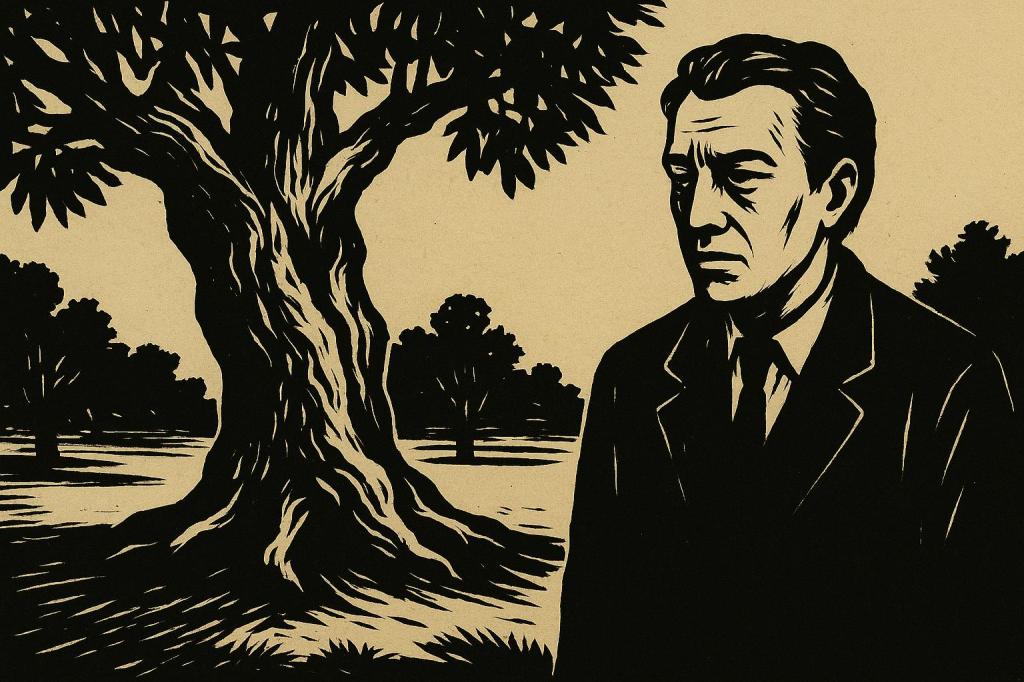
“I exist, that is all, and I find it nauseating.”
It begins with a tree root.
Ordinary, rough, buried in the earth. Antoine Roquentin looks at it—and suddenly, everything changes.
The root is no longer just part of the landscape. It’s too present. Too real.
And for the first time, he feels it: the weight of existence.
Not as an idea.
As a physical, unsettling sensation. A thickness in the air. A buzzing behind the eyes. A sickness in the gut.
It’s not fear. Not depression. Not even despair.
It’s something deeper and harder to name: a raw awareness that the world is not built on reason, or order, or purpose.
Things just are.
And that, he realizes, is unbearable.
Nausea is not a story about events. It’s a diary of perception.
Roquentin doesn’t discover a secret. He doesn’t survive a tragedy. He simply wakes up to the absurd truth most of us spend our lives trying not to notice:
That life doesn’t come with instructions. That meaning isn’t built in.
That things—and people—just exist. And that existence has no explanation.
This is not a nightmare imposed from outside.
It’s not a political system or a futuristic machine.
It’s the most ordinary horror of all: the feeling of being alive, with no reason why.
Nausea is the first true existential novel—not because it preaches philosophy, but because it makes you feel what philosophy tries to explain.
And it all starts with a man sitting alone in a café, touching the world—and finding it too real to bear.
Historical Context: The World Before Collapse
Nausea was published in 1938, just one year before the world would break apart again.
Europe was tense. Fascism had taken hold in Italy and Germany. The Spanish Civil War was burning. Old beliefs—God, reason, progress—no longer felt reliable. People were anxious, disillusioned, and increasingly aware that the ground beneath them was not as solid as it once seemed.
In philosophy, a shift was happening too. For centuries, Western thought had focused on big ideas—universal truths, systems, logic. But now, a new kind of question was emerging:
Not what is truth?
But what does it feel like to be here?
Sartre had just returned from studying in Berlin, where he encountered the work of Edmund Husserl and Martin Heidegger—two thinkers who weren’t trying to define the world, but to describe how we experience it.
Their ideas planted something in Sartre. He didn’t want to write another academic treatise. He wanted to show what it’s like to live with the realization that there is no grand meaning—only presence, perception, and choice.
So he created Antoine Roquentin.
And placed him not in history, but in the present moment—quiet, mundane, and terrifying in its ordinariness.
Nausea wasn’t written to warn us about war, or to describe a broken society.
It was written to explore something smaller, and somehow more frightening:
The moment you realize the world doesn’t explain itself.
And that you still have to live in it anyway.
Sartre in Formation: Writing the First Existential Novel
By the time Jean-Paul Sartre began writing Nausea, he was already drifting away from the world of abstract philosophy.
He had studied traditional philosophy: ethics, metaphysics, logic. But it all felt too distant, too detached from lived experience. So he went to Berlin in 1933 to explore a new path: phenomenology, the study of how we perceive the world before we name or interpret it.
That changed everything.
He returned to France with a growing discomfort—an awareness that beneath daily life was something deeper, stranger, and more unsettling. Sitting in cafés, walking through Le Havre, he began to feel the edges of reality blur. The familiar became alien. Objects lost their labels. The world was no longer a place—it was just there.
That’s when he started writing Nausea.
Not as a theory, but as a diary. A fictional man—Antoine Roquentin—quietly unraveling under the pressure of his own consciousness.
Roquentin doesn’t suffer a dramatic tragedy.
He suffers clarity.
“My thought is me: that’s why I can’t stop. I exist because I think… and I can’t prevent myself from thinking. At this very moment—it’s frightful—if I exist, it is because I am horrified at existing.”
Sartre didn’t want to explain existence. He wanted to feel it.
And in Nausea, he did just that—turning philosophical ideas into something visceral, messy, and painfully real.
Story Overview: Nothing Happens, and That’s the Point
Antoine Roquentin is a man without much to do.
He’s living in the quiet French town of Bouville, renting a room, and half-heartedly working on a biography of a long-dead nobleman. He wanders through cafés, museums, libraries, and parks. He eats alone. He writes in his journal.
And slowly, the world starts to feel wrong.
Objects seem strange. People seem distant. His own body begins to revolt—not physically, but ontologically. He can’t explain it. There’s no plot twist. No villain. Just a quiet, creeping realization:
Nothing in the world is necessary. Not the chair. Not the tree. Not himself.
Existence, he begins to see, is not logical or orderly. It’s just there—thick, heavy, indifferent.
Even language breaks down. Words begin to feel like lies. His old routines—small talk, polite gestures, scholarly work—feel hollow.
He meets an old lover, Anny, hoping for connection, maybe clarity. But they’ve both changed. Or maybe they never really knew each other at all. Their encounter is less a reunion than a confirmation: the gap between people cannot be closed with memory.
And then comes the moment.
In a park, Roquentin sees the root of a chestnut tree. It should be ordinary. But he can’t explain it away. The root is real—too real. It’s not beautiful or symbolic. It just is, pulsing with unnecessary presence. And suddenly, he’s overwhelmed.
“The Nausea has not left me and I don’t believe it will leave me so soon; but I no longer have to bear it, it is no longer an illness or a passing fit: it is I.”
That is his collapse.
And his awakening.
At the end of the novel, Roquentin isn’t healed. He hasn’t found a solution.
But he begins to understand that if meaning doesn’t exist in the world, it must be created. Not found. Not inherited. Made.
Even in a senseless world, there is still music. Still art. Still the possibility of making something true.
Not to escape the absurd—but to stand inside it, and sing anyway.
Major Themes: The Anxiety of Being
Nausea is not a book of action. It’s a book of recognition.
The slow, internal shift when the familiar stops feeling safe—and starts feeling absurd.
What Sartre gives us through Roquentin is not just a man in crisis, but a man stripped of illusion. And in that space, existential themes emerge with startling clarity.
1. Existence Precedes Essence
This is the cornerstone of Sartre’s philosophy:
We are not born with a purpose. We simply exist—and then we define who we are.
Roquentin’s crisis comes from realizing this fully. The world doesn’t come pre-packaged with meaning. The objects around him aren’t symbols. They just are. And so is he.
“Every existing thing is born without reason, prolongs itself out of weakness, and dies by chance.”
It’s not romantic. It’s not tragic. It’s just… true.
And that truth, when fully felt, is overwhelming.
2. Nausea as Philosophical Awakening
The title is more than a symptom. It’s a metaphor for clarity.
Roquentin feels sick not because something is wrong—but because, for the first time, he sees the world without filters. The nausea comes when he touches the raw, unexplained fact of being.
“I was just thinking… that here we are, eating and drinking, to preserve our precious existence, and that there’s nothing, nothing, absolutely no reason for existing.”
This is Sartre’s existential insight:
Once you realize that meaning is not given, the result is not freedom at first—it’s vertigo.
3. The Burden of Radical Freedom
If nothing has meaning on its own, then we are the ones who must create it.
That sounds empowering. But Roquentin doesn’t feel empowered. He feels alone.
There’s no God. No fate. No moral compass waiting to be found.
“We are left alone, without excuse.”
This is freedom—not as liberation, but as responsibility.
And that weight is almost unbearable.
4. Alienation from Others
Roquentin’s nausea doesn’t only come from objects. It comes from people too.
He listens to others talk and hears rehearsed phrases, empty gestures, routines that no longer mean anything. He tries to reconnect with Anny, but finds only distance.
He is surrounded by people—but completely alone.
Existential alienation isn’t loneliness in the usual sense.
It’s the realization that other people are strangers in a world where you no longer speak the same language.
5. The First Step Toward Meaning
Despite its bleakness, Nausea ends on a note of quiet resolve.
Roquentin doesn’t return to society. He doesn’t make peace with God.
But he considers writing a novel. Not because it will fix anything—but because creation might be the only answer to absurdity.
This is where Sartre’s philosophy begins to bloom:
The world has no meaning.
So what will you do with that?
Influence and Legacy: The Novel That Named the Feeling
Nausea didn’t just tell a story—it captured a sensation many had felt but few could explain.
It was one of the first novels to express the existential condition not as an idea, but as an atmosphere. Not through characters making speeches, but through a man quietly coming apart in a quiet town, overwhelmed by the fact of being alive.
And in doing so, Sartre gave us something that would outlive the novel itself:
A name for the invisible crisis.
A vocabulary for modern disconnection.
A mirror for the mind waking up in a world that no longer explains itself.
1. A New Kind of Novel
Before Nausea, novels were usually driven by plot, character arcs, or moral resolution. Sartre broke all of that.
- No grand events.
- No emotional climax.
- No answers.
The novel’s structure—fragments, internal monologue, quiet spaces—reflected the very uncertainty it tried to portray. It paved the way for writers like Camus, Beckett, and even later figures like Murakami and Houellebecq.
It opened the door for literature that didn’t comfort or entertain—but confronted.
2. Existentialism Becomes Personal
Philosophy had often lived in lecture halls, written in technical language for a few.
But with Nausea, Sartre pulled it into the café, the bedroom, the street. He made it personal. Emotional. Embodied.
He showed that the questions of freedom, alienation, and selfhood weren’t abstract—they were felt in the gut. In the way your skin crawls when nothing feels real. In the hollowness of small talk. In the sickening realization that nothing holds you in place but yourself.
This changed what philosophy could be—and who it was for.
3. A Legacy That Still Echoes
Even now, nearly a century later, Nausea continues to resonate.
In a world full of stimulation, distraction, and artificial meaning, many people still wake up—often alone—and ask:
- Why am I here?
- What is this all for?
- Is this it?
Sartre didn’t answer those questions. He didn’t try.
Instead, he offered something braver: he sat with them. And through Roquentin, invited us to do the same.
Because maybe meaning doesn’t begin with certainty.
Maybe it begins with discomfort. With nausea.
With a man looking at a tree root—and refusing to pretend it makes sense.
Roquentin’s crisis was quiet.
It unfolded in cafés, libraries, and empty streets.
A man alone with his thoughts, wrestling with the weight of existing.
But what happens when you’re not alone?
When the silence is replaced by other people—each carrying their own fear, their own illusion, their own gaze?
What if the room gets smaller?
And freedom doesn’t feel like escape, but exposure?
What if Hell isn’t a punishment.
What if Hell is other people.

