
By Jean-Paul Sartre
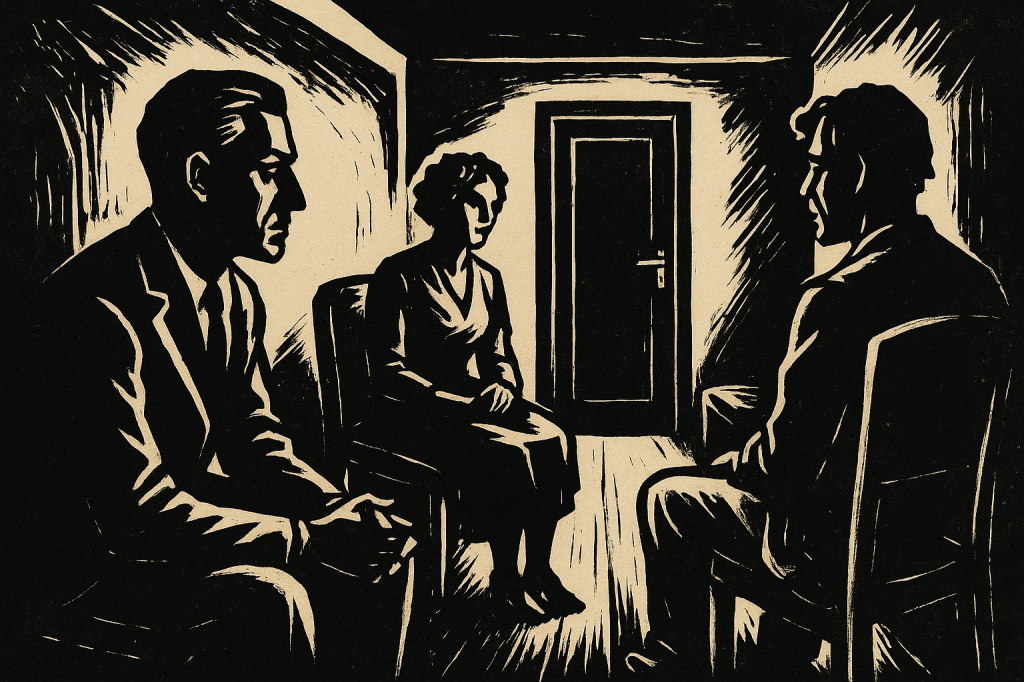
“So this is hell. I’d never have believed it. You remember all we were told about the torture chambers, the fire and brimstone, the ‘burning marl.’ Old wives’ tales! There’s no need for red-hot pokers. Hell is—other people!”
A door clicks shut.
Three people stand in a room with no mirrors, no windows, no sleep, and no escape.
No one screams.
No one bleeds.
They talk. They lie. They reveal themselves.
And they realize something far worse than eternal pain:
They will be known.
No Exit is one of the most compact and brutal plays ever written.
It has no set changes. No external action. No God, no devil, no executioner.
The characters arrive in Hell expecting punishment—and find only each other.
At first, they try to maintain appearances:
“I’m here by mistake.”
“IWasn’t so bad.”
“I still have dignity.”
But then the games begin.
With no distractions, no secrets, and nowhere to hide, the truth begins to seep out.
And with it, the horrifying realization:
There’s no need for demons.
We’ll destroy each other just fine.
Historical Context: A War, a Stage, and a Mirror
The year was 1944.
Paris was still under Nazi occupation. The city of lights had grown dim—its cafés haunted by silence, its streets watched by uniforms. Public gatherings were monitored. Speech was censored. Fear was routine.
And in the middle of it all, a play premiered.
It wasn’t patriotic.
It wasn’t heroic.
It took place in a single room, with no escape and no happy ending.
Jean-Paul Sartre’s No Exit was performed for the first time in May 1944, just weeks before the Liberation of Paris.
And it hit a nerve.
During the war, philosophy had become a matter of survival.
No longer locked in ivory towers, it moved underground—into bars, basements, and behind enemy lines. It whispered through the Resistance. It looked fascism in the face and asked:
What does it mean to be free when you are not?
For Sartre, this wasn’t abstract.
He had served in the army. Been captured by the Germans. Spent nearly a year in a POW camp.
He wrote, he taught, he organized—all under occupation.
No Exit wasn’t written as entertainment.
It was a provocation. A mirror. A question:
When everything is taken from you—when all that remains is other people—what do you see in their eyes?
And what do they see in yours?
The war stripped away illusions.
The play made sure we couldn’t put them back on.
Sartre’s War Within – Creating No Exit
While Europe burned, Sartre was watching people—closely.
He saw soldiers become killers.
Neighbors become strangers.
Friends disappear into roles: collaborator, resister, coward, hero.
And behind every action, he saw a deeper war:
The war between who we are and who we pretend to be.
After escaping the German POW camp in 1941, Sartre returned to occupied Paris and joined a circle of underground intellectuals. He began writing plays—not because he loved the stage, but because the stage allowed philosophy to breathe in real time.
No footnotes. No jargon. Just people, on a stage, stripping themselves bare.
He had been working on ideas about the gaze—how our identity is never fully our own, because we are always being seen, judged, interpreted by others.
That’s what No Exit became: a room with no mirror, because you no longer need one.
The others will do the job just fine.
“You are—your life, and nothing else.”
Each character in the play tries to escape accountability:
- Garcin clings to the illusion of being brave.
- Estelle needs to be desired.
- Inez demands power.
But the room has no exit because truth has no exit.
You are what you’ve done.
And everyone sees it.
For Sartre, No Exit was more than a play.
It was his philosophy, performed under pressure.
A stage where freedom wasn’t the ability to choose—but the inability to hide.
Story Overview: The Room That Judges You
The play begins simply enough:
A man is led into a room.
Garcin, a journalist, is escorted by a mysterious valet into what looks like a perfectly ordinary drawing room. No chains. No flames. No torture devices.
But there are three sofas. And no mirrors.
And the door locks behind him.
He’s told he won’t sleep. Ever.
That’s all.
Soon, he’s joined by Inez, a postal clerk. Sharp-tongued, skeptical, unblinking.
Then by Estelle, a wealthy socialite. Elegant. Vain. Anxious to see herself in a mirror.
The three strangers quickly realize: this isn’t a mistake.
This is Hell.
And there’s no executioner.
There’s just… each other.
At first, they try to keep up appearances.
Garcin claims he’s there by error. That he died for his beliefs, shot as a political dissident.
Estelle insists she did nothing wrong.
Inez watches, waits, and doesn’t believe a word.
They speculate on the rules. Maybe it’s all random. Maybe they’ve been mismatched.
But the room has no distractions.
And the lights never go out.
So they talk.
And what starts as small talk spirals into confessions, contradictions, and cruelty.
As truths emerge, the punishment becomes clear:
- Garcin was not a martyr—he was a coward who tried to run, then let others die.
- Estelle murdered her own child, then tried to carry on with parties and perfume.
- Inez manipulated a woman into killing her own husband.
None of them want to take responsibility.
But they can’t stop the others from seeing them—really seeing them.
And that’s the point.
“One always dies too soon—or too late. And yet one’s whole life is complete at that moment, with a line drawn neatly under it, ready for the summing up.”
Each character becomes the torturer of the others—not with violence, but with the unrelenting force of judgment.
They accuse. They seduce. They beg to be believed.
They try to rewrite their stories using each other as mirrors.
But it’s no use.
The truth isn’t what they say.
The truth is what they cannot stop the others from seeing.
In a final twist, the door to the room opens.
Freedom is right there.
And no one leaves.
Because Hell isn’t the room.
It’s what the room has revealed.
“Well, well, let’s get on with it…”
The play ends not with flames, but with something colder:
an eternity of being seen, but never understood.
Of being locked in the roles you can no longer escape.
Major Themes: The Hell We Make Together
In No Exit, there is no fire, no devil, no punishment from above.
There’s only a room.
And three people.
And the realization that we don’t need to be tortured.
We do it to ourselves. And to each other.
Here are the central ideas Sartre drags into the light:
1. “Hell is Other People” – The Look That Defines Us
This is the line everyone remembers—usually out of context.
Sartre didn’t mean that other people are always awful.
He meant that being seen by others is inescapable—and painful.
In the play, each character wants to control how the others see them:
- Garcin wants to be respected.
- Estelle wants to be desired.
- Inez wants to dominate.
But none of them succeed.
“You’re—your life, and nothing else.”
You are not what you claim to be.
You are what the others see.
And in No Exit, the gaze is merciless.
2. Bad Faith – The Lies We Tell Ourselves
Each character walks in with a mask.
They tell neat stories to justify their lives.
They bend the truth. They seek validation.
This is what Sartre called bad faith: the human tendency to deny our freedom by clinging to comforting roles.
In the room, those roles fall apart.
- Garcin can’t lie about his cowardice when Inez keeps calling it out.
- Estelle can’t pretend she was a victim when the facts won’t bend.
- Inez embraces her cruelty—but still hides behind sarcasm and scorn.
Hell isn’t punishment.
It’s self-deception exposed.
3. Freedom as Responsibility
Even in Hell, Sartre insists: we are still free.
We may be trapped, but we still choose how to respond.
And that’s the true torment—not that the characters are being controlled, but that they are fully responsible for their past, and for their refusal to change.
There is no scapegoat left.
No one to blame.
No way to pretend the choice wasn’t yours.
Freedom doesn’t liberate them.
It condemns them
4. Identity as a Mirror
With no mirrors in the room, each character becomes a reflection for the others.
They beg for affirmation. They fight for control.
They try to hold on to a version of themselves that the others refuse to accept.
This is the existential tragedy:
We are social beings—but society won’t give us the truth we want.
“Inez, you see me as I am. I’m a coward.”
Garcin can’t escape that sentence.
Because once it’s been seen, it can’t be unseen.
5. The Inescapability of Judgment
The door eventually opens.
But no one walks through it.
Because it’s not the room that traps them—it’s the dynamic.
They are bound together not by chains, but by need:
- The need to be understood.
- The need to be loved.
- The need to be forgiven.
But in No Exit, no one gets what they need.
They stay.
Because they still want the others to say,
You’re not what you fear you are.
And that need is the most damning trap of all.
Legacy and Bridge – The Silence Outside the Room
No Exit was more than a play.
It was a turning point—for Sartre, for existentialism, and for 20th-century culture.
Until then, existentialism was a quiet rebellion—a conversation in cafés, a cluster of essays read by the few.
But in 1944, with No Exit, it stepped onto the stage and spoke out loud.
And people listened.
A Philosophy in Performance
This was existentialism with teeth.
It didn’t lecture. It didn’t theorize.
It dramatized.
Sartre showed that freedom wasn’t glorious—it was unbearable.
That the self wasn’t sovereign—it was fragile.
That Hell wasn’t fire—it was exposure.
And he did it with just three characters in a room.
This was the existential condition, made public:
No God. No guidance. No exit.
Only the choices we make—and the truths we can’t outrun.
Ripples Through Culture
The impact wasn’t limited to philosophy.
After No Exit, a new kind of art emerged—stripped down, claustrophobic, morally unresolved:
- Samuel Beckett’s Endgame and Waiting for Godot carried the same quiet torment: characters stuck, waiting, talking in circles.
- Ingmar Bergman’s films—like Persona and Through a Glass Darkly—explored identity through isolation and interpersonal distortion.
- Modern television and single-location dramas—from 12 Angry Men to The Twilight Zone—borrow this structure: a room, a conflict, and a truth no one wants to say aloud.
Even the phrase “Hell is other people” entered common language—misunderstood, yes, but undeniably powerful.
It became a cultural shorthand for the discomfort of being known too well.
A Stage for the Human Condition
More than any of his essays, No Exit made Sartre a global figure.
Because it wasn’t just about Hell.
It was about us.
Our need to be seen.
Our fear of being seen.
Our fragile, desperate attempts to hold onto a version of ourselves—through the eyes of others.
And that’s why it still matters.
Because the room hasn’t changed.
We’re still in it.
The Silence Outside the Room
But what happens when the room disappears?
When there are no others left to reflect you—only the sky, the sea, and the sound of your own footsteps?
What if judgment is replaced by indifference?
The next story isn’t about torture.
It’s about emptiness.
A courtroom. A beach. A funeral.
And a man who doesn’t lie—because he has nothing left to protect.

