By Samuel Beckett
“Nothing to be done.”
That’s the first line.
The curtain rises to a bare stage:
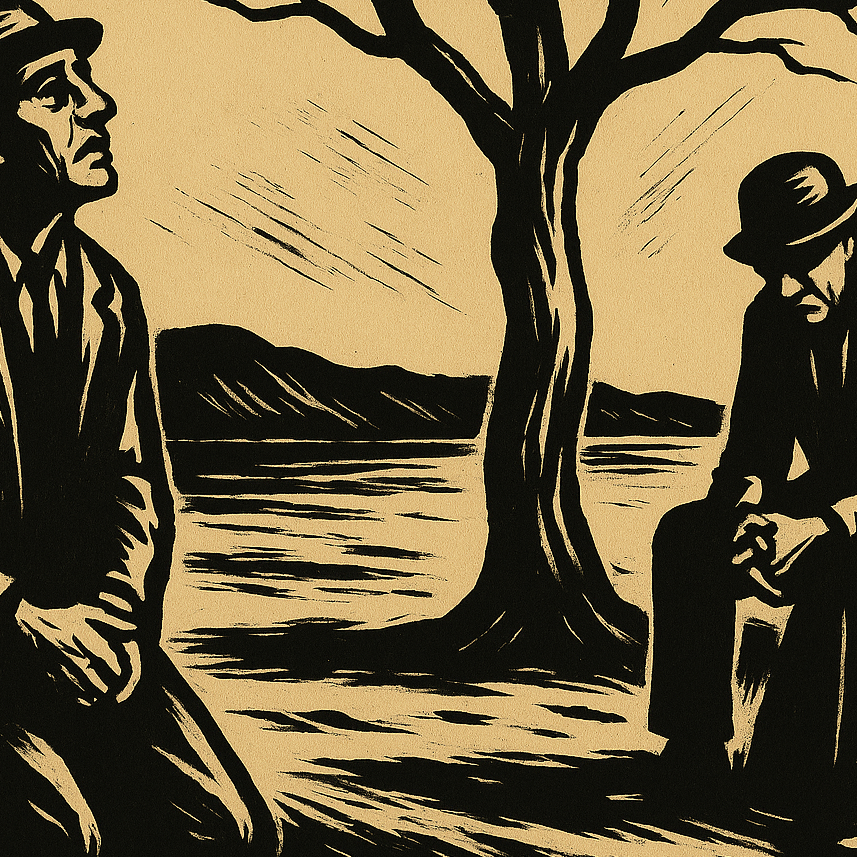
A country road. A tree. Evening.
Two men. Worn shoes. Bowler hats.
Talking. Waiting. Pausing.
For someone named Godot, who never arrives.
That’s it.
That’s the play.
It unfolds in silence, repetition, and absurdity.
Nothing happens. Then it happens again.
And yet—something shifts.
Not in the world, but in us.
Because Waiting for Godot is not about plot.
It’s about existence.
Samuel Beckett’s 1953 masterpiece didn’t just break the rules of theater—it dismantled them.
No rising action. No climax. No resolution.
Just two men stuck in a loop of time, thought, and doubt.
They joke. They fight. They try to leave.
But they always come back.
Because they are waiting.
And waiting is the human condition.
“Let’s go.”
“We can’t.”
“Why not?”
“We’re waiting for Godot.”
Historical Context – Post-War Europe, Absurdism, and Beckett’s Silence
When Waiting for Godot premiered in 1953, Europe was still covered in the ash of war.
The Holocaust had shattered faith in reason.
Hiroshima had made progress feel monstrous.
And the Cold War had replaced peace with tension—an anxious, waiting kind of war.
In this vacuum of meaning, traditional narratives felt dishonest.
Hope sounded naive. The hero’s journey rang hollow.
Enter Samuel Beckett, an Irish writer who had lived through two world wars and fought in the French Resistance—not with speeches, but with silence.
Beckett distrusted words. He once said that every word was “an unnecessary stain on silence and nothingness.”
Waiting for Godot emerged from this despair—not as protest, but as portrayal.
Beckett wasn’t trying to tell us how to live.
He was showing us how it feels when life refuses to move forward, and yet still demands that we go on.
This was Absurdism—not as a philosophy to follow, but as a stage to stand on.
A mirror that didn’t offer reflection, but emptiness.
“They give birth astride of a grave, the light gleams an instant, then it’s night once more.”
Beckett took the post-war silence and made it visible.
He built a play out of absence.
He turned waiting into a metaphor so universal that the word “Godot” has entered our language as a symbol for anything we hope for that never arrives.
Story Overview – Two Men. One Tree. No Godot.
There is no plot in the traditional sense.
No rising action. No climax. No resolution.
Just two men—Vladimir and Estragon—waiting by a barren tree.
They say they’re waiting for someone named Godot.
They don’t know who he is, or what he’ll do.
Only that he’s supposed to come.
Tomorrow, maybe. Or not at all.
“We always find something, eh Didi, to give us the impression we exist?”
They fill the time with meaningless banter, philosophical meanderings, slapstick routines.
They consider leaving. Hanging themselves. Leaving again.
But they don’t.
Each day repeats the last.
Evening falls.
A boy arrives, says Godot won’t come today, but surely tomorrow.
Then the curtain drops.
That’s it.
But in that repetition, Beckett reveals everything:
A world where people wait for meaning instead of creating it.
Where hope itself becomes a trap.
Where the absence of action is the action.
Major Themes – Absurdism, Waiting, and the Search for Meaning
It’s not a story about answers.
It’s a story about waiting for answers that never arrive.
Let’s unpack what that means.
1. The Absurd Condition
At its core, Waiting for Godot is the embodiment of absurdism—the tension between our search for meaning and the universe’s silence.
“We always find something, eh Didi, to give us the impression we exist?”
Vladimir and Estragon crave purpose.
But all they have is each other, a tree, and the hollow promise of Godot.
They don’t even know who Godot is.
A savior? A master? God?
It doesn’t matter.
Because Beckett’s point isn’t who Godot is—it’s why we wait at all.
We live in expectation.
Of love, of justice, of meaning.
But what if it never comes?
2. Time and Repetition
Time in Godot isn’t linear.
It’s circular.
Every day is the same. Every night ends the same way.
“Was I sleeping while the others suffered?”
Like Sisyphus pushing his rock, Vladimir and Estragon repeat their performance without progress.
Memory fails them.
Purpose evades them.
The only thing that continues is the act of waiting.
3. Language as a Crutch—and a Cage
The characters talk. Endlessly.
But their language is full of contradictions, diversions, and unfinished thoughts.
They’re not communicating—they’re filling the void.
“We’re not tied?”
“I don’t hear a word.”
“A damn lot of good that does us.”
Beckett shows us the failure of language to deliver meaning.
Words don’t fix their situation.
They only distract from it.
4. Companionship as Survival
For all their bickering, Vladimir and Estragon need each other.
“Don’t touch me! Don’t question me! Don’t speak to me! Stay with me!”
They talk about suicide, abandonment, and escape—
But never truly separate.
In a world without structure, human connection is the last anchor.
5. Godot – The Absent Answer
Godot is the elephant offstage.
He never appears, never clarifies, never explains.
And that’s the point.
Godot is whatever we hope will make it all make sense—
God, salvation, purpose, progress.
But in Beckett’s world, that answer doesn’t arrive.
And maybe it never will.
“Nothing happens. Nobody comes, nobody goes. It’s awful.”
Legacy – How a Play Where Nothing Happens Changed Everything
When Waiting for Godot premiered in 1953, audiences didn’t know what to make of it.
A play where nothing happens?
Two men wait under a tree and talk in circles?
No plot, no climax, no resolution?
But that was the point.
Beckett wasn’t trying to entertain.
He was trying to expose — the void beneath our distractions, the absurdity behind our routines, the silence that follows when meaning doesn’t arrive.
“We are all born mad. Some remain so.”
What began as confusion became revelation.
Godot cracked open the stage.
It shattered traditional storytelling, laying the groundwork for theatre of the absurd — where form reflected philosophy, and absence was as important as action.
Beckett’s influence echoes everywhere:
- Eugène Ionesco’s The Bald Soprano and Rhinoceros, where dialogue collapses into nonsense
- Harold Pinter’s long pauses and minimalist dread
- Tom Stoppard’s existential hijinks in Rosencrantz and Guildenstern Are Dead
But it didn’t stop at theatre.
You can feel Godot’s DNA in modern culture:
- In The Leftovers, where people search for meaning after a senseless event
- In BoJack Horseman, where humor masks despair and no lesson is ever quite learned
- In The Sopranos, Mad Men, and any show that dares to let characters sit in their own silence
- In memes that ask if “Godot” is just capitalism, or mental health, or love, or the next update — always promised, never arriving
Beckett’s brilliance was in showing that existential dread isn’t loud—it’s quiet.
It looks like a pause. A habit. A wait.
And in doing so, he made the absurd visible.
He made us laugh at the void.
And in that laugh, maybe—just maybe—we found a kind of survival.
But still…
We keep coming back.
We keep watching.
We keep waiting.
What Comes After the Waiting
If Godot taught us how to endure, then the next question is inevitable:
What happens when time itself collapses?
When past, present, and future become unmoored—when memory offers no comfort, and death is no longer a mystery but a destination you’ve already visited?
From waiting beneath a barren tree to drifting through the ruins of Dresden, our journey into existentialism continues.
To a world where a soldier survives one of history’s greatest horrors, only to be unstuck in time. Where alien abduction feels no stranger than war. Where the only constant is absurdity—and the only response left is dark, satirical surrender.
>>> Next: Slaughterhouse-Five
 Eksistensialisme.com